—
메타크리틱
0개
DLC
Steam
플랫폼
인디, 시뮬레이션
장르
출시 예정
플랫폼별 가격 비교
가격 히스토리
차트 로딩 중...
게임 소개
You are a freelance pilot working a single ship, a fragile budget, and a logbook full of jobs nobody else will fly. Haul cargo and passengers between stations, prospect bodies for ore and ice, stand up surface refineries, build out a fleet, and take on the megamissions that earn a name out past the frost line.
Every trajectory you fly is one a real spacecraft could fly. There is no "go to planet" button. The propagator never cheats on your behalf.
The simulation is built on a closed-form two-body propagator and a patched-conic sphere-of-influence model — the same baseline mission designers used in the Apollo era and still use today for first-order trajectory work.
Every trajectory you fly is one a real spacecraft could fly. There is no "go to planet" button. The propagator never cheats on your behalf.
Real orbital mechanics, not an approximation
The simulation is built on a closed-form two-body propagator and a patched-conic sphere-of-influence model — the same baseline mission designers used in the Apollo era and still use today for first-order trajectory work.
- Kepler's equation solved every tick with a Danby starter and Newton–Raphson iteration; the hyperbolic form handles escape and flyby trajectories
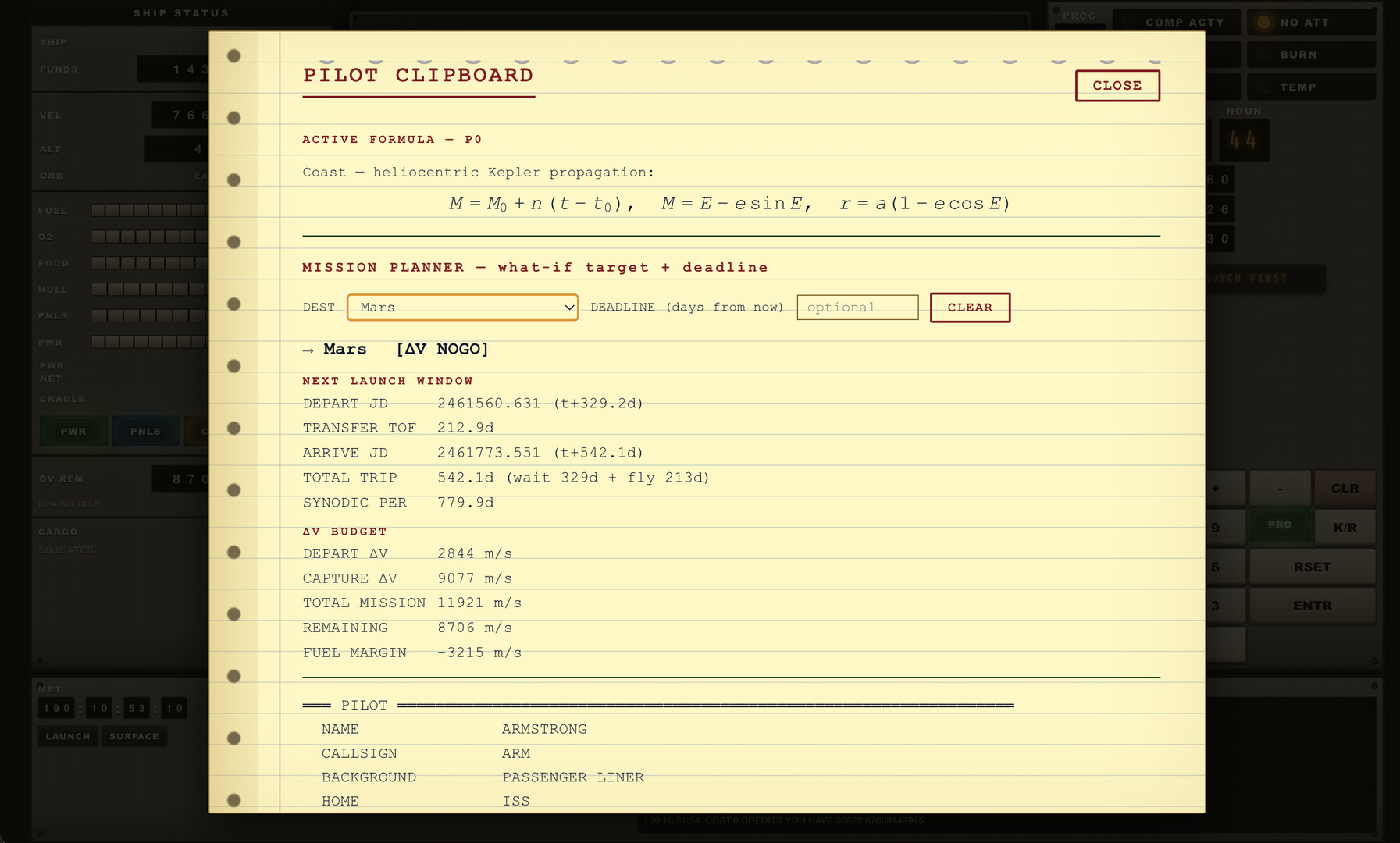
- Lambert's problem solved with Izzo's 2015 universal-variable algorithm and a Householder iterator — a porkchop search over departure and arrival dates picks the minimum-Δv window, the same way NASA's Trajectory Browser does
- Hohmann transfers compute the phase angle and Δv for the cheapest two-impulse hop between circular orbits
- The vis-viva equation governs speed at every point on every conic, elliptic through hyperbolic
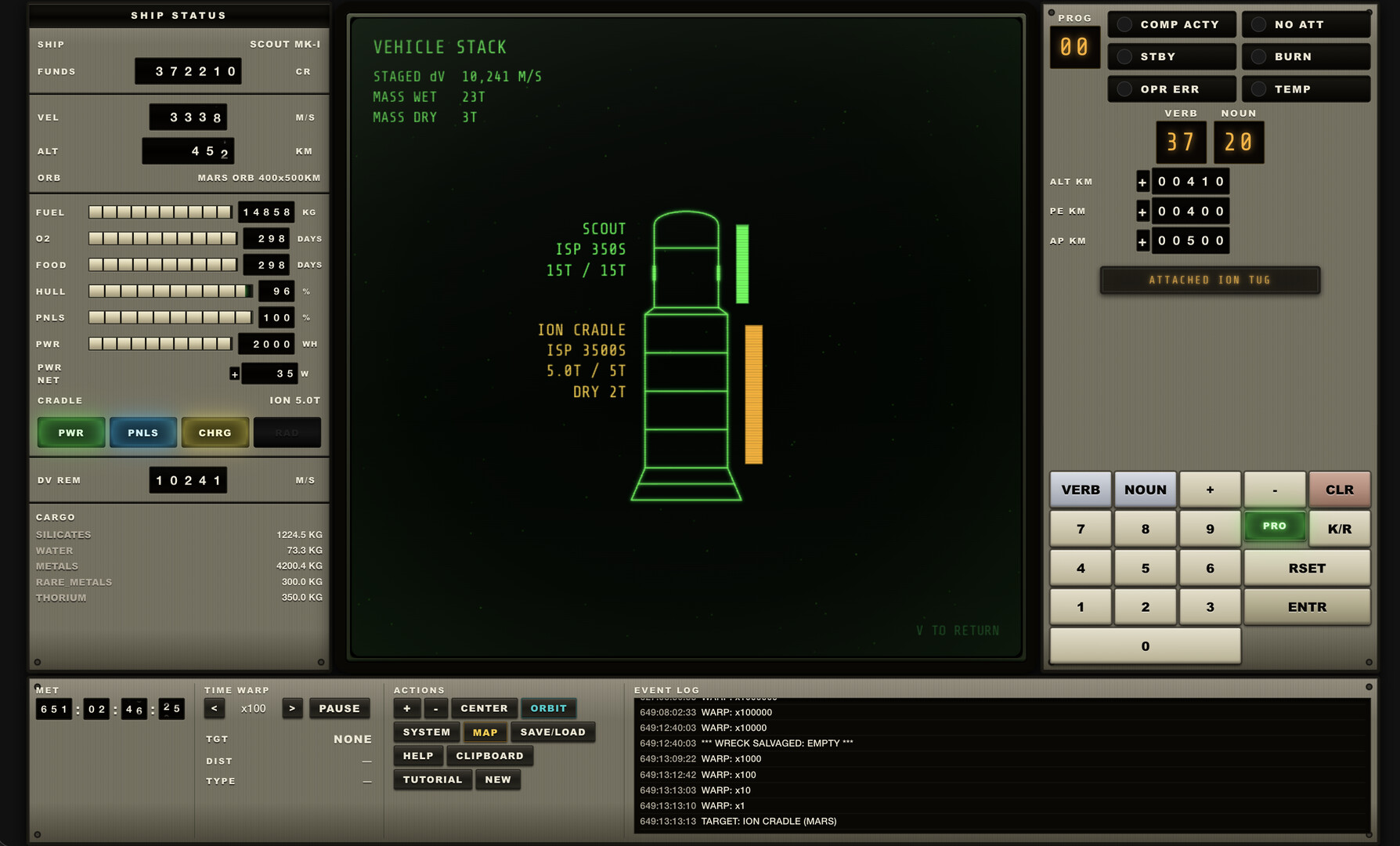
- The Tsiolkovsky rocket equation costs out every burn, with a two-stage form for cradle-and-ship staging
- Hill-sphere SOI radii decide when you leave one body's gravity well and enter another's, with nested moon SOIs taking precedence
- Gravity assists modeled as hyperbolic flybys with turn angle set by periapsis radius and excess velocity
- Solar power falls off as 1/r² from the Sun; RTG output decays on the real Pu-238 half-life of 87.7 years
What you do
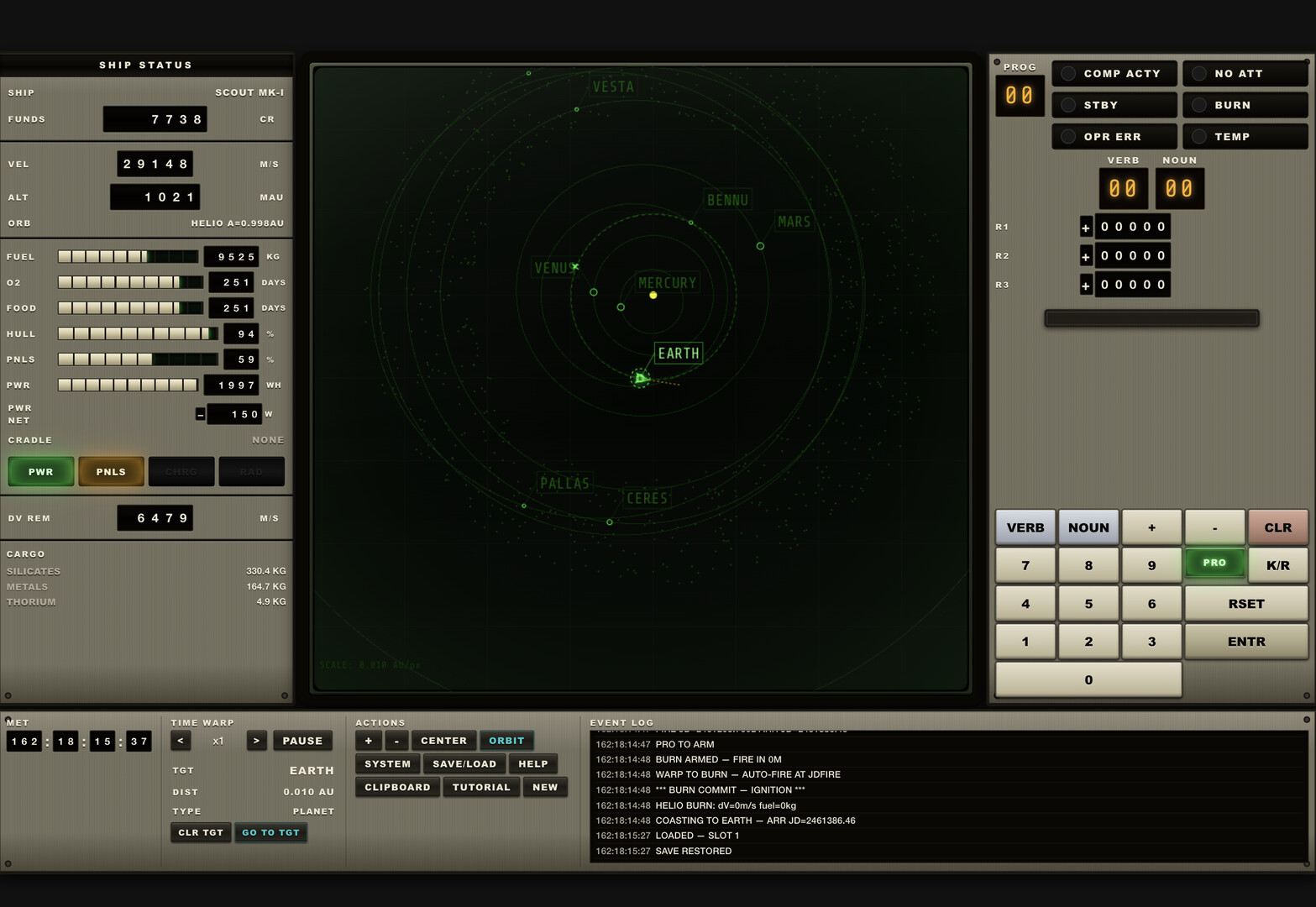
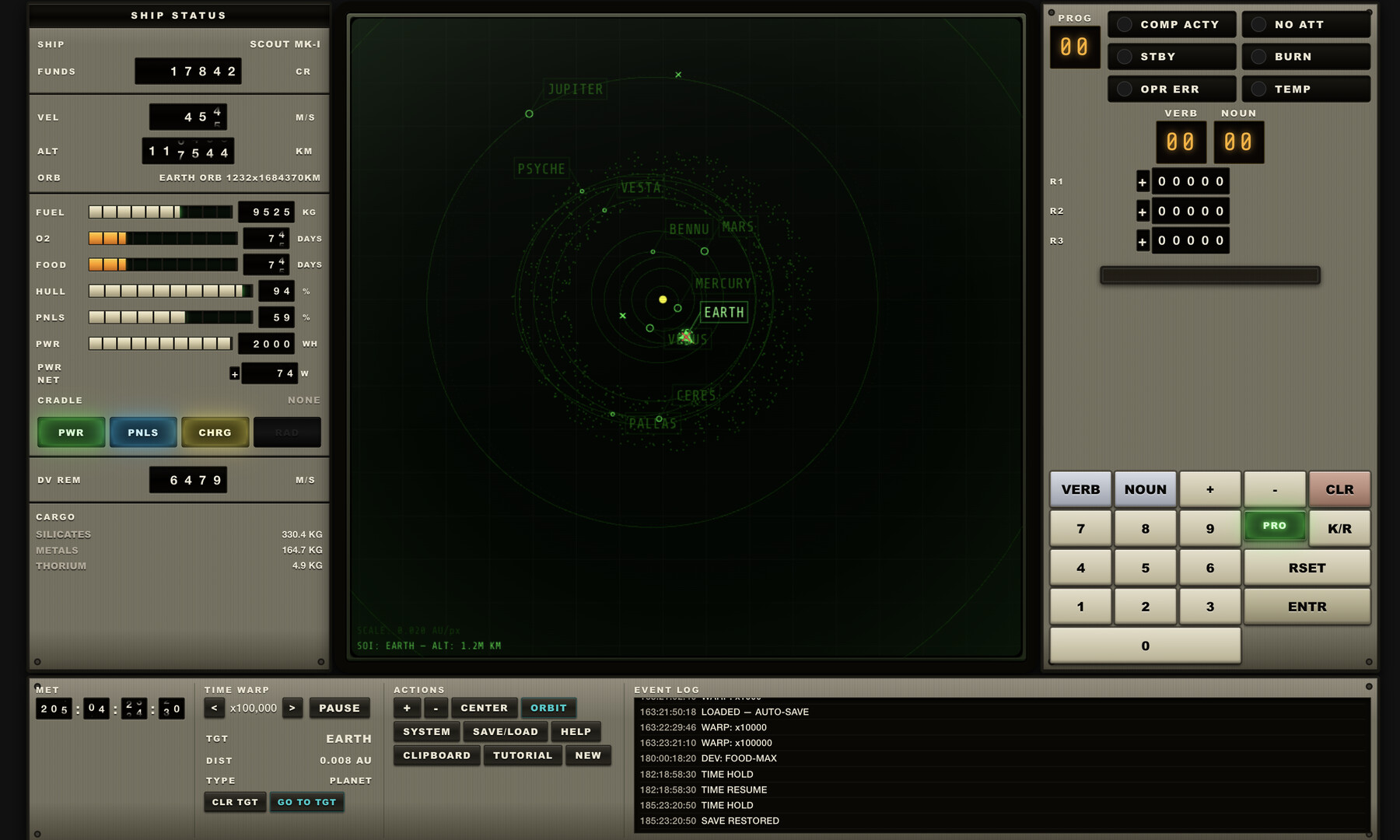
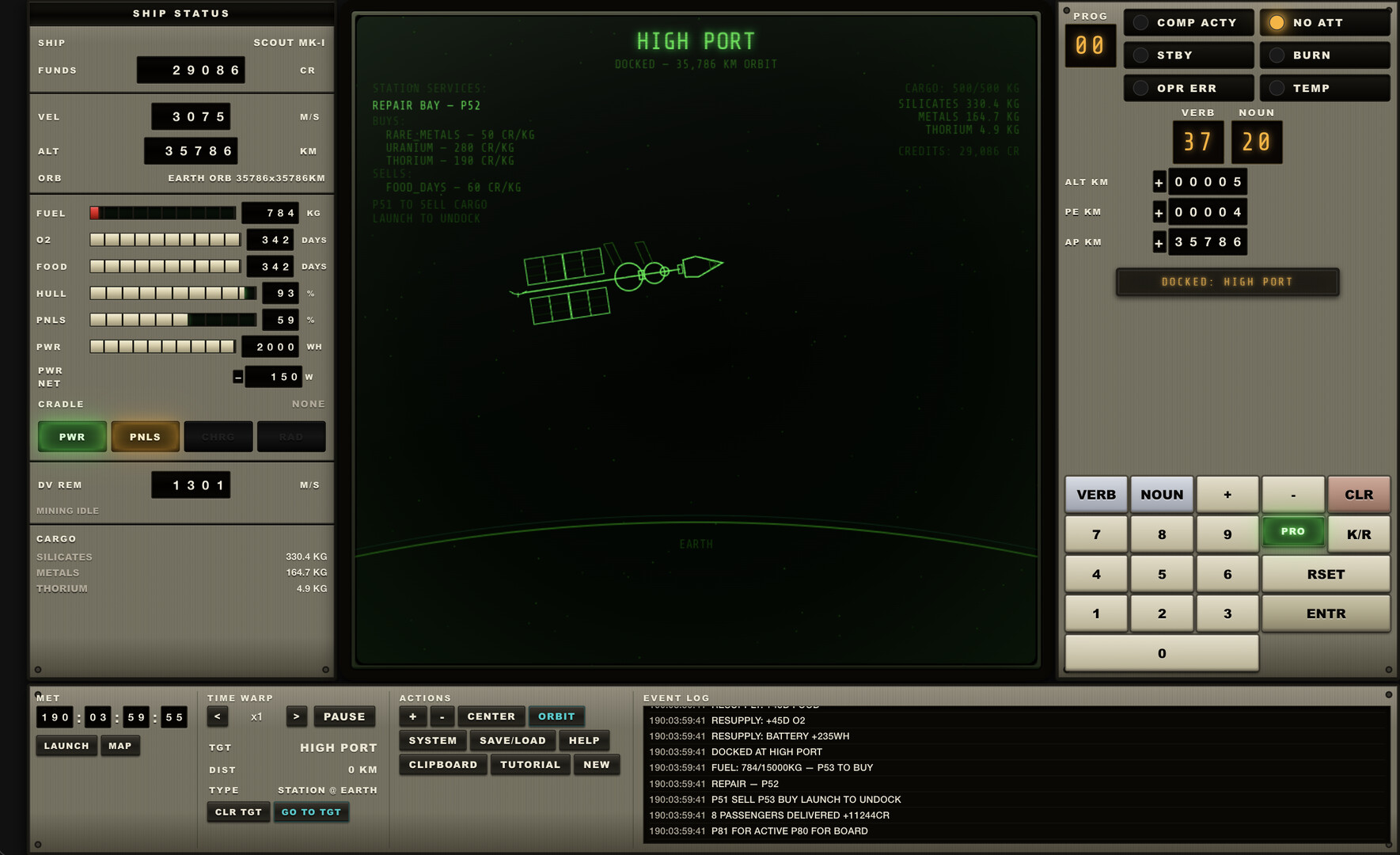
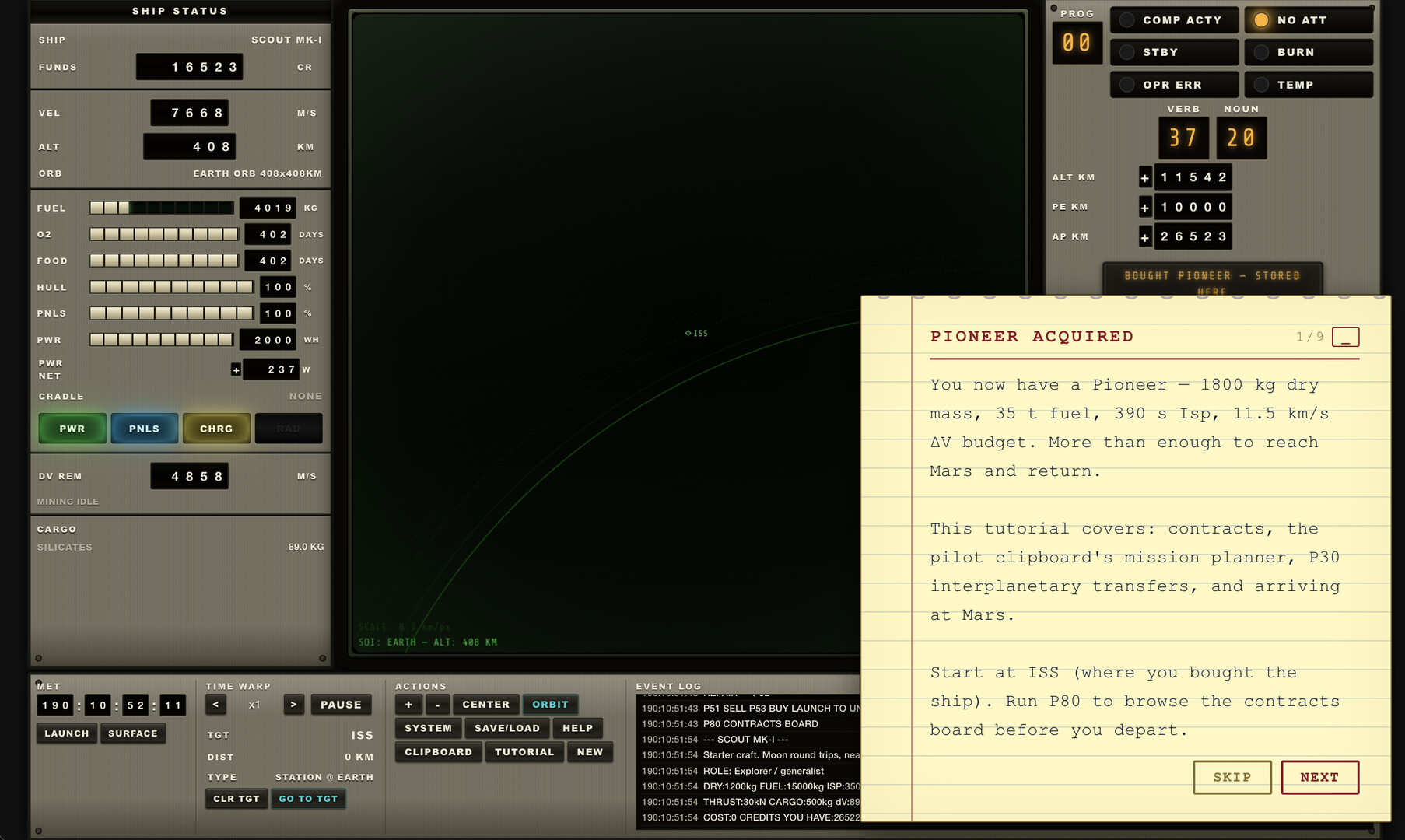
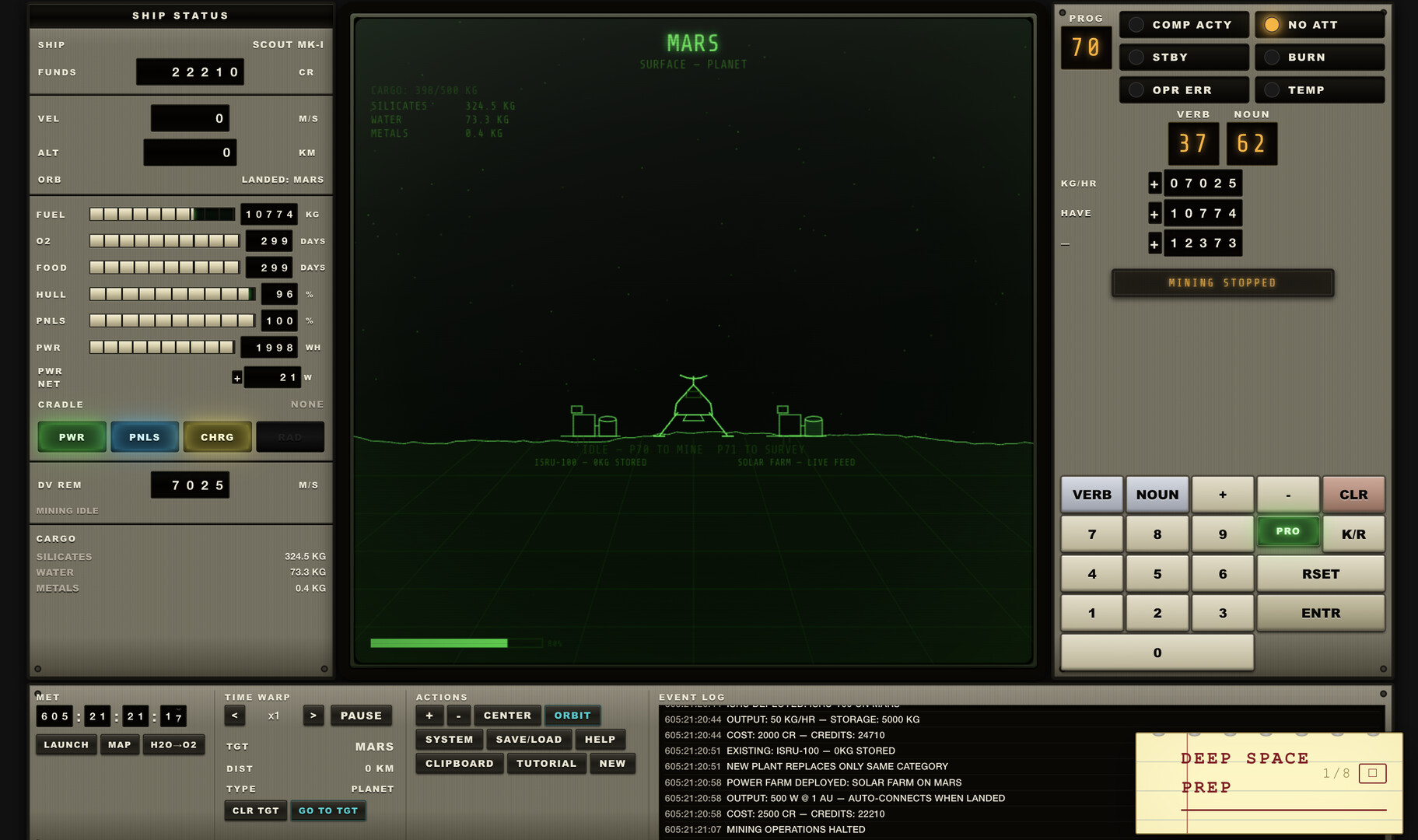
- Plan and execute burns from an Apollo-style DSKY: local orbit changes, Hohmann transfers, rendezvous, circularization, interplanetary Lambert transfers, gravity assists, and full heliocentric multi-leg trajectories
- Run cargo, passenger, resupply, and survey contracts across the solar system; build station reputation to unlock trusted and elite tiers, then chase the eight endgame megamissions
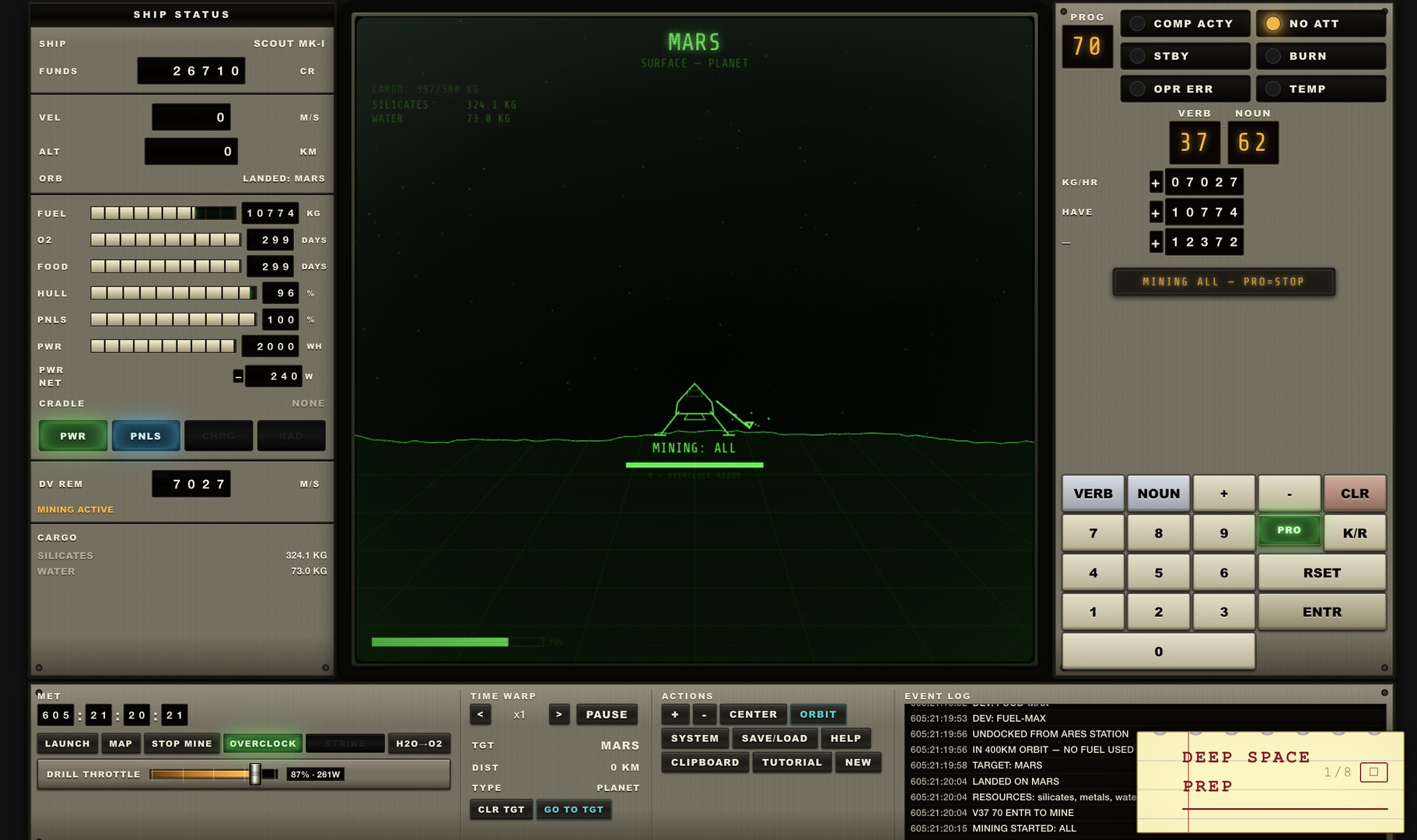
- Land on planets, moons, and minor bodies; mine ore, ice, volatiles, and fissionables; deploy ISRU refineries and bioharvest plants to sustain operations past Jupiter
- Buy and fly a fleet of six ship classes, from the bare Scout to the ion-driven Endurance; build staged propulsion cradles for missions your ship can't reach on its own tanks
- Survive micrometeorite swarms in LEO, the belt, and Saturn's rings; solar flares that fry unshielded avionics; depleted batteries; and the slow decay of your RTGs over the years
- Install upgrades — Whipple shields, panel shrouds, flare-hardened avionics, radioisotope generators — and salvage the wrecks of pilots who didn't
Features
- Patched-conic orbital mechanics — no approximations, no autopilot
- Apollo DSKY flight computer interface with 20+ programs
- 38-body solar system: planets, moons, asteroids, and Kuiper Belt objects
- 8 endgame megamissions with permanent career titles
- 6 ship classes with distinct role bonuses
- Procedural SID/Amiga chiptune soundtrack
- Runs fully offline — no network connection required