—
메타크리틱
0개
DLC
Steam
플랫폼
인디, 전략
장르
출시 예정
플랫폼별 가격 비교
가격 히스토리
차트 로딩 중...
게임 소개
A Text-Driven AVG Set in a Republican-Era Espionage World
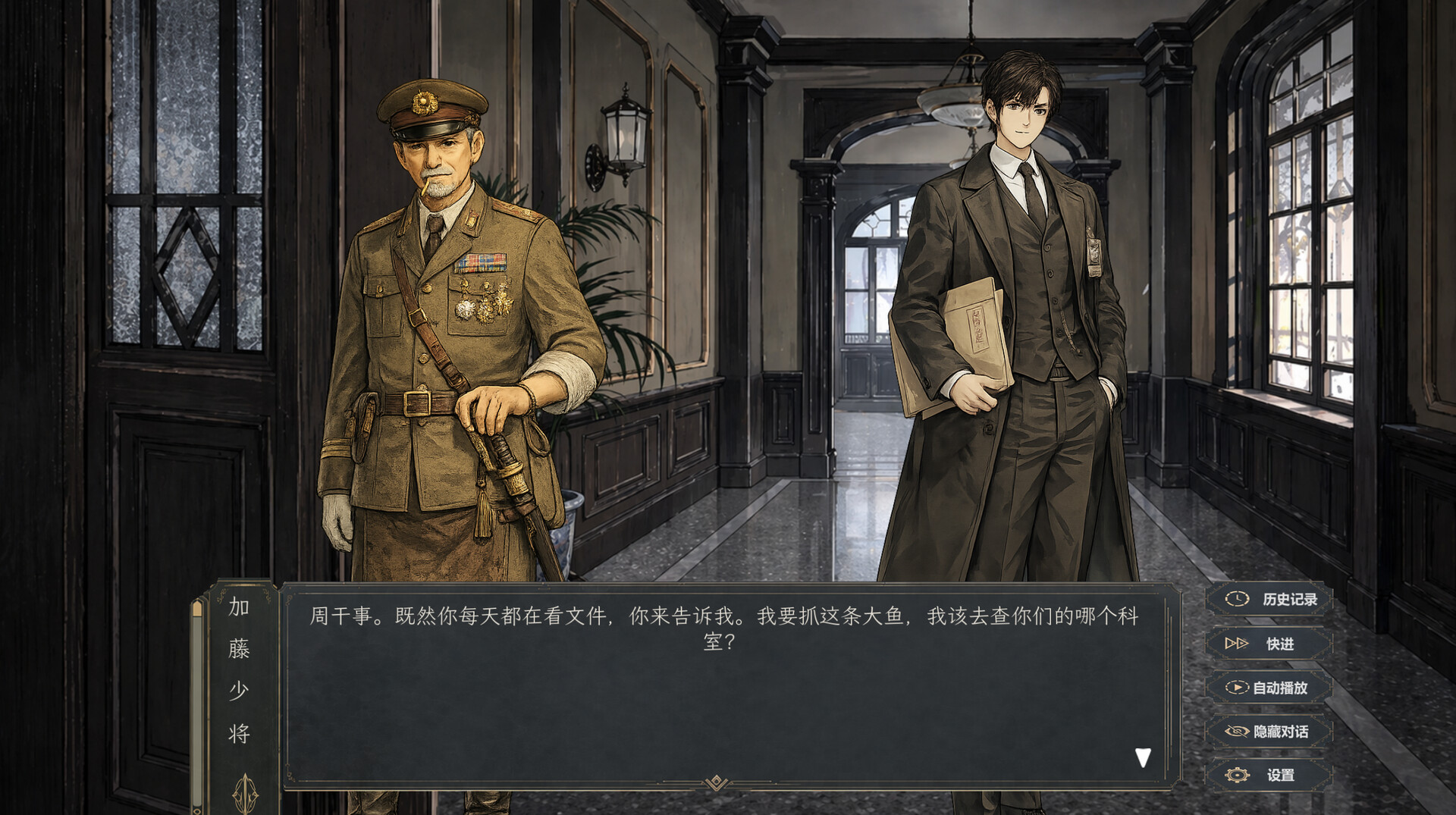
Set inside a government bureau during a chaotic era of modern Chinese history, the game blends undercover work, intelligence gathering, inspections, screening, and internal power struggles. It focuses on survival and identity manipulation under an oppressive bureaucratic system. On the surface, you are an ordinary clerk. In truth, you stand at the center of an intelligence war where multiple factions collide.
Chapter-Based Suspense with Investigation and Mind Games
The game uses a chapter-based structure, with each chapter built around a complete incident: a mission is triggered, witnesses are questioned, evidence is collected, suspects are confronted, and the case reaches a temporary conclusion before its consequences unfold. Players do not simply read the story; they actively investigate, analyze clues, judge motives, and take positions.
A Hybrid of Text AVG and Deductive Confrontation
This is not a pure visual novel. Investigation, evidence management, testimony comparison, interrogation, and conclusion-building are integrated into the narrative. Players must distinguish facts from motives, misdirection, and hidden agendas, combining the pleasure of reading with the satisfaction of deduction.
Multiple Playthroughs Are Not Repetition, but Deeper Understanding
One of the game’s core features is that the same clues can mean different things across different playthroughs. In the first run, players make seemingly reasonable judgments with limited information. In later runs, newly unlocked insight tags, hidden perspectives, and additional details allow players to reinterpret old clues and overturn earlier conclusions. The goal is not simply to add more plot, but to let players truly experience the reversal of “rereading the same world.”
Political Intrigue Is Not Background Lore, but Gameplay Pressure
The power struggle is not something players merely watch from the sidelines. You are directly involved in it. Who you trust, what you hide, what you reveal, which questions you ask first, and which evidence you hold back will all affect the investigation route, character attitudes, false leads, and chapter outcomes. You are not an observer, but a participant in the manipulation of power and narrative.
Lies, Procedures, and Narrative Itself Can Become Weapons
The game is not only about “who the culprit is,” but also about who is shaping the truth, who controls the narrative, and who benefits most from making you understand the situation in a certain way. Files, evidence, testimonies, procedures, timelines, a comforting remark, or even an ordinary official document may all conceal a deeper layer of manipulation.
Heavy Narrative, Tight Clue Loops
Rather than focusing on complex character development systems, the game emphasizes chapter pressure, exposure risk, alertness, public opinion pressure, and other lightweight state systems. Failure is not limited to a simple Game Over. It may take the form of misjudgment, missed clues, scapegoating, identity exposure, or bad endings, creating a continuous sense of pressure that better fits the espionage thriller experience.