—
메타크리틱
0개
DLC
Steam
플랫폼
액션, 인디
장르
출시 예정
플랫폼별 가격 비교
가격 히스토리
차트 로딩 중...
게임 소개
THE CHAIN OF COMMAND IS BROKEN
Salvo is a tactical immersive sim with thousands of ways leading to one objective: breaking the enemy's war machine.
Central command has been destroyed. The last strategic force still capable of continuing the war is your underground missile program. There is no one left to give you orders. Which technology to research, which missile to design, what to produce, and when to fire — all of it is your decision.
They have billion-dollar radars; you have $20,000 drones. They have layered air defenses; you have saturation salvos, decoy warheads, and launchers emerging from underground.
You cannot win in open war. So you will not fight one. The objective is clear. The path is yours.
THE ENEMY WAR MACHINE
You are not striking a city, a base, or a single radar; you are fighting an interconnected war machine.
Radars scan the sky. Interceptor batteries select targets. Factories replenish depleted stocks. Convoys carry new missiles to the front. Fighter aircraft hunt for your launchers. Allied reconnaissance networks try to understand every movement in the region.
You do not need to destroy everything to defeat them. Sometimes silencing a single factory, blinding a single radar, or delaying a single convoy can disrupt the entire defensive order.
YOUR WAR BEGINS UNDERGROUND
The enemy has superiority in the sky, at sea, and in the open terrain. Your advantage begins where you cannot be seen.
Your underground tunnel network is not merely a shelter. It is the main battlefield where you produce missiles, store them, prepare your launchers, and plan your attacks.
You expand your tunnel network across different depth levels, build launchers, and increase your production and storage capacity. Opening and closing launchers, reducing your surface signature, and avoiding reconnaissance are all part of the war.
The order you build underground determines the outcome of the war in the air. You cannot create a major salvo with too few launchers. You cannot saturate the defense without stockpiles. If you spend your budget poorly, even the best technology may remain beyond your ability to field.
LAYERED AIR DEFENSE WORKS LIKE A REAL NETWORK
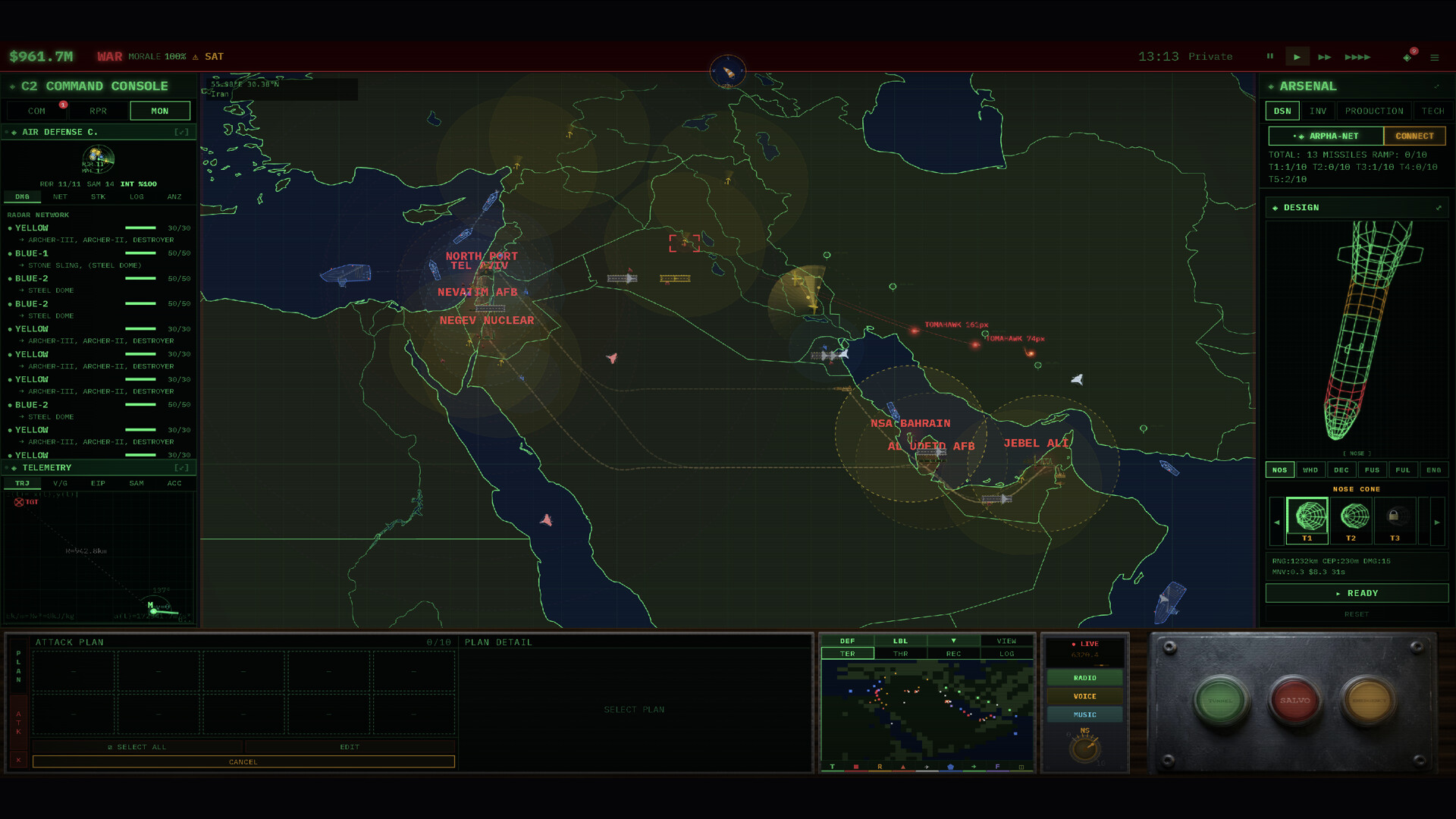
The enemy defense is not a single shield. It is a layered network of interconnected radars, interceptor batteries, point defenses, ammunition stocks, factories, and decision cycles.
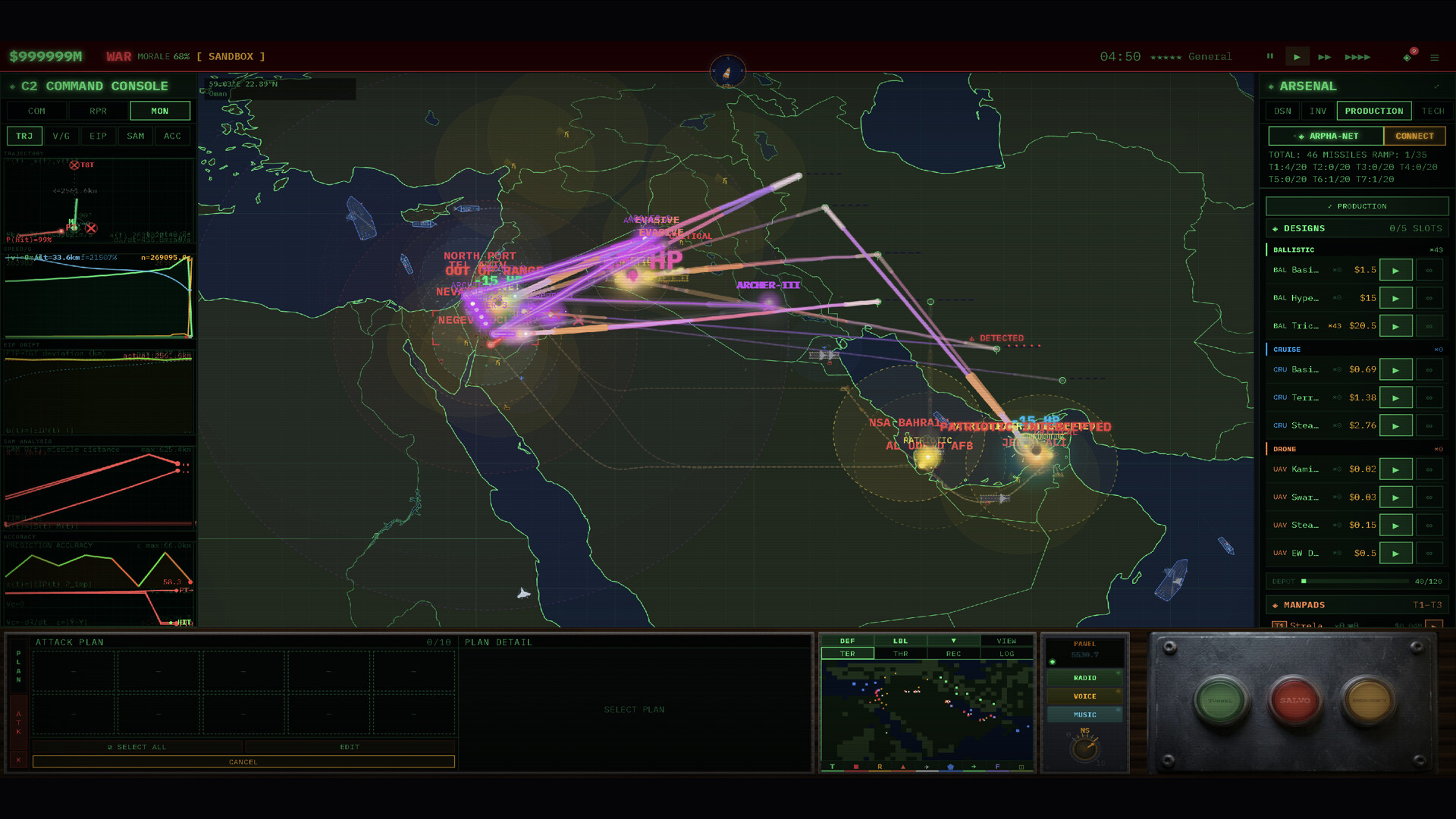
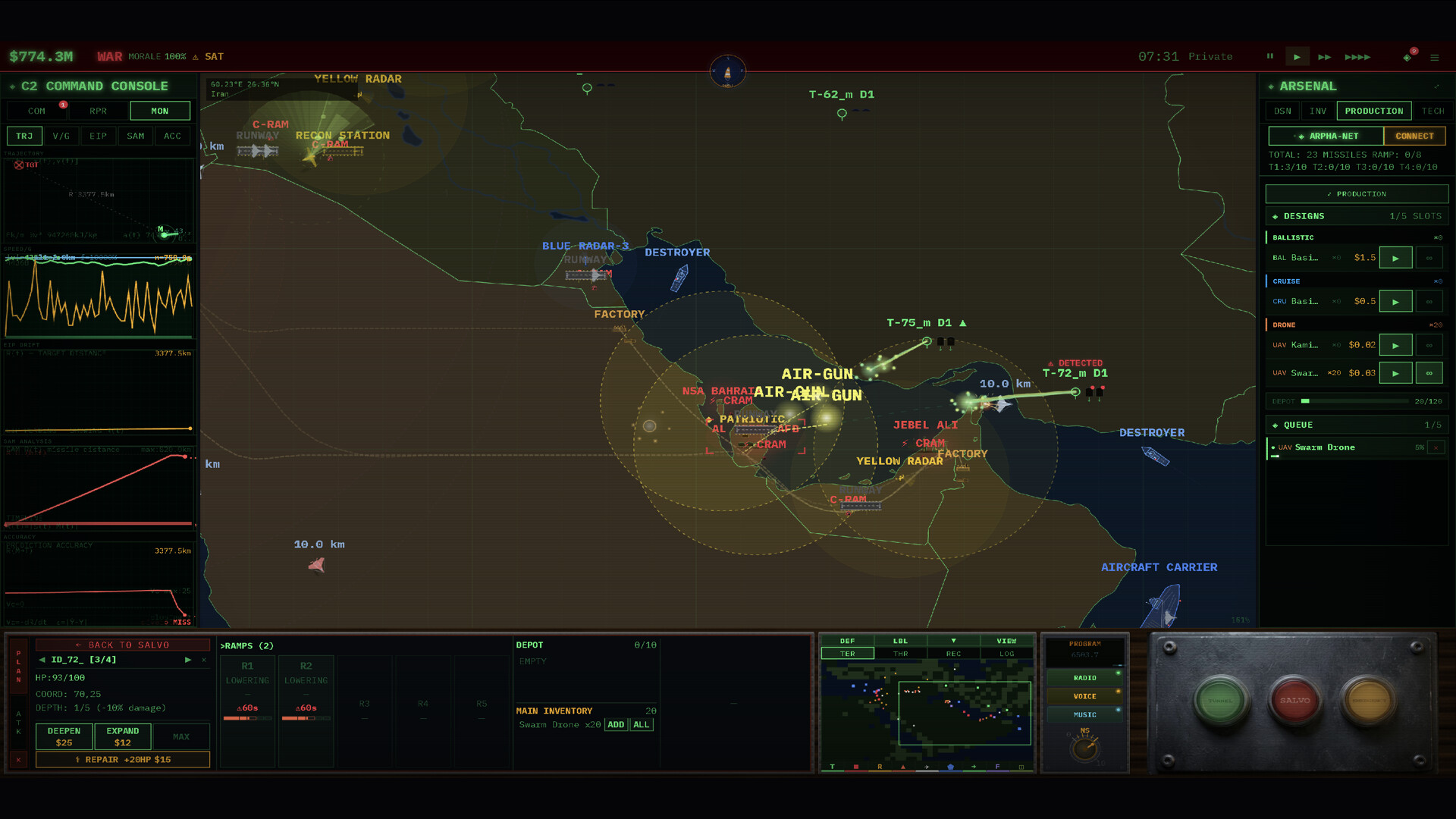
Archer-3, Archer-2, Stone Sling, Steel Dome, Patriotic, Yurt Korur, and close-in defense guns operate across different layers against different threats.
Each system has its own range, reaction time, radar coverage, ammunition capacity, reload behavior, and target priority.
When a radar detects a target, which interceptor is assigned, whether ammunition remains in stock, and the target's route, altitude, speed, and maneuvering all determine the outcome. In Salvo, air defense is not decoration — it is a real-time defensive architecture.
DESIGN THE WEAPON, THEN PRODUCE IT
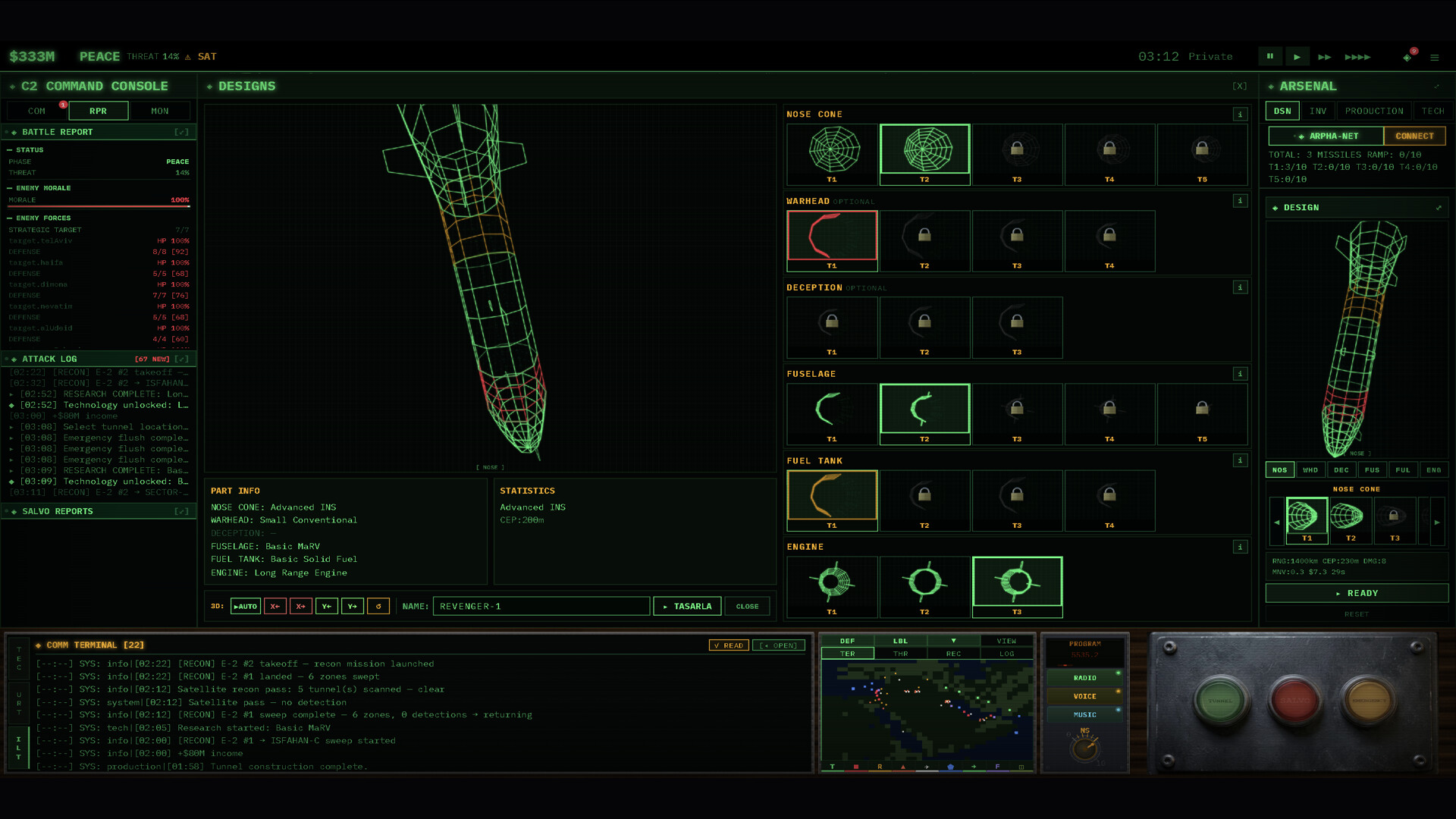
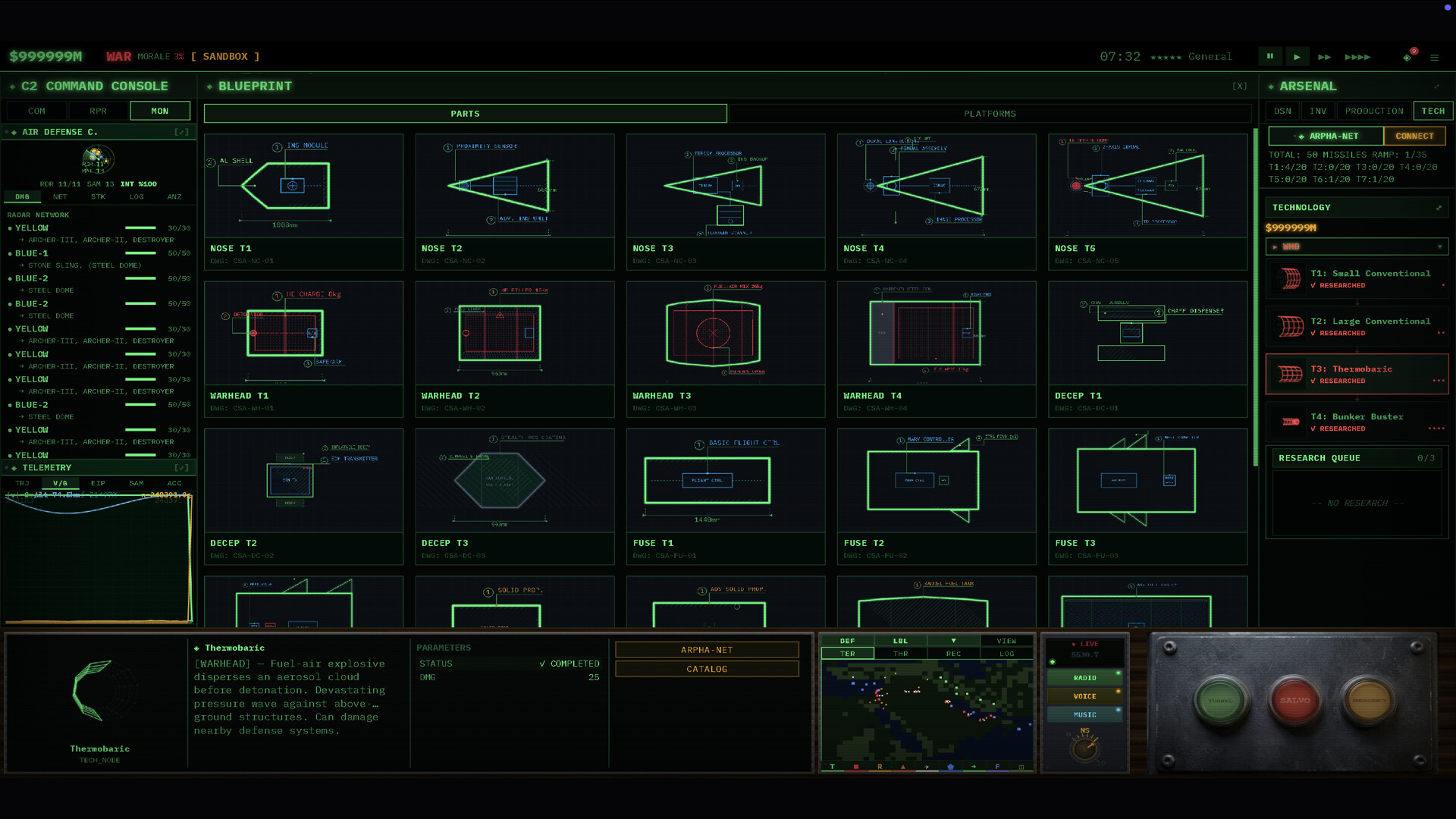
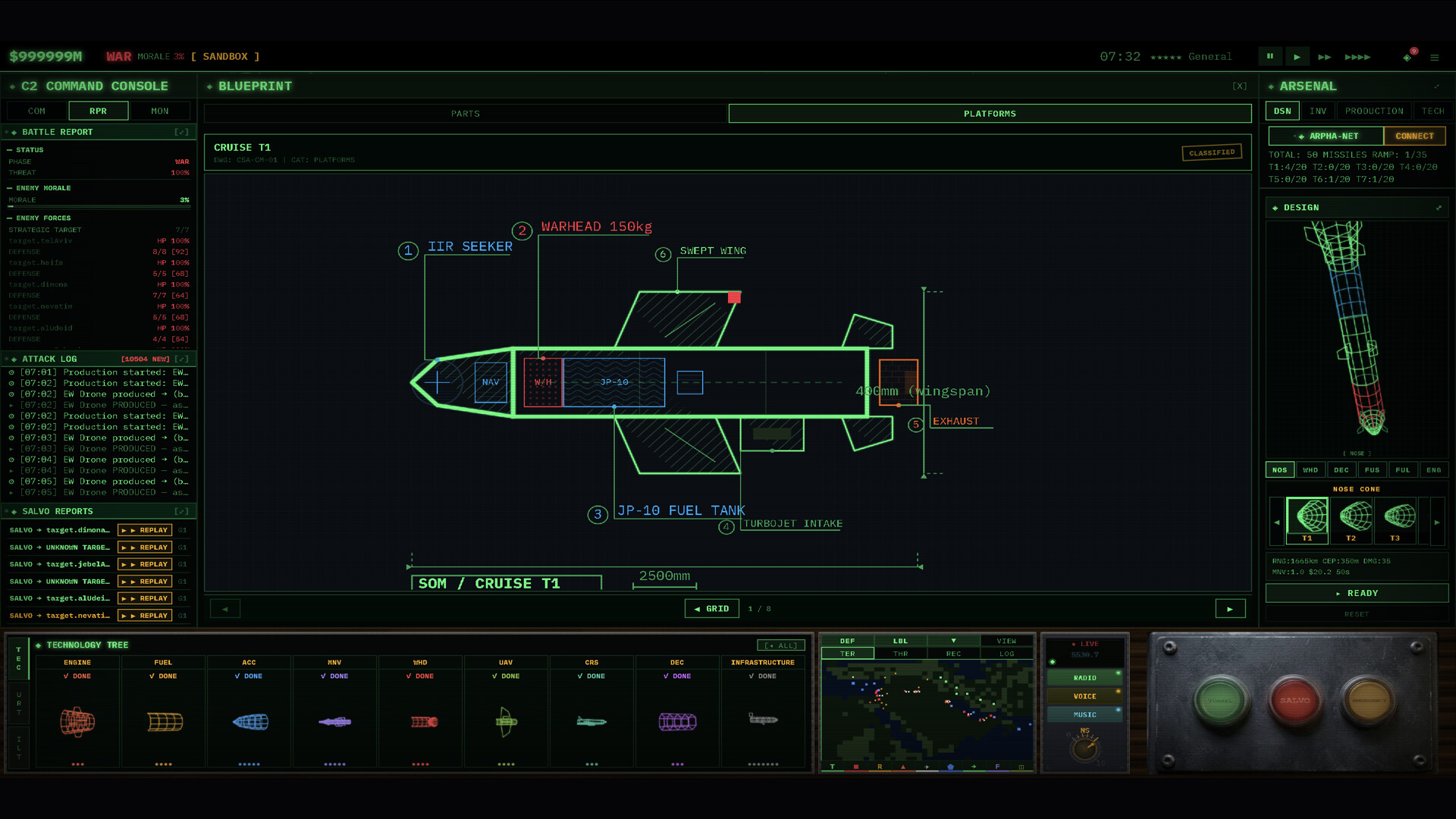
In Salvo, missiles are not selected from a ready-made catalog. Every weapon is a modular design built from the technologies you have unlocked.
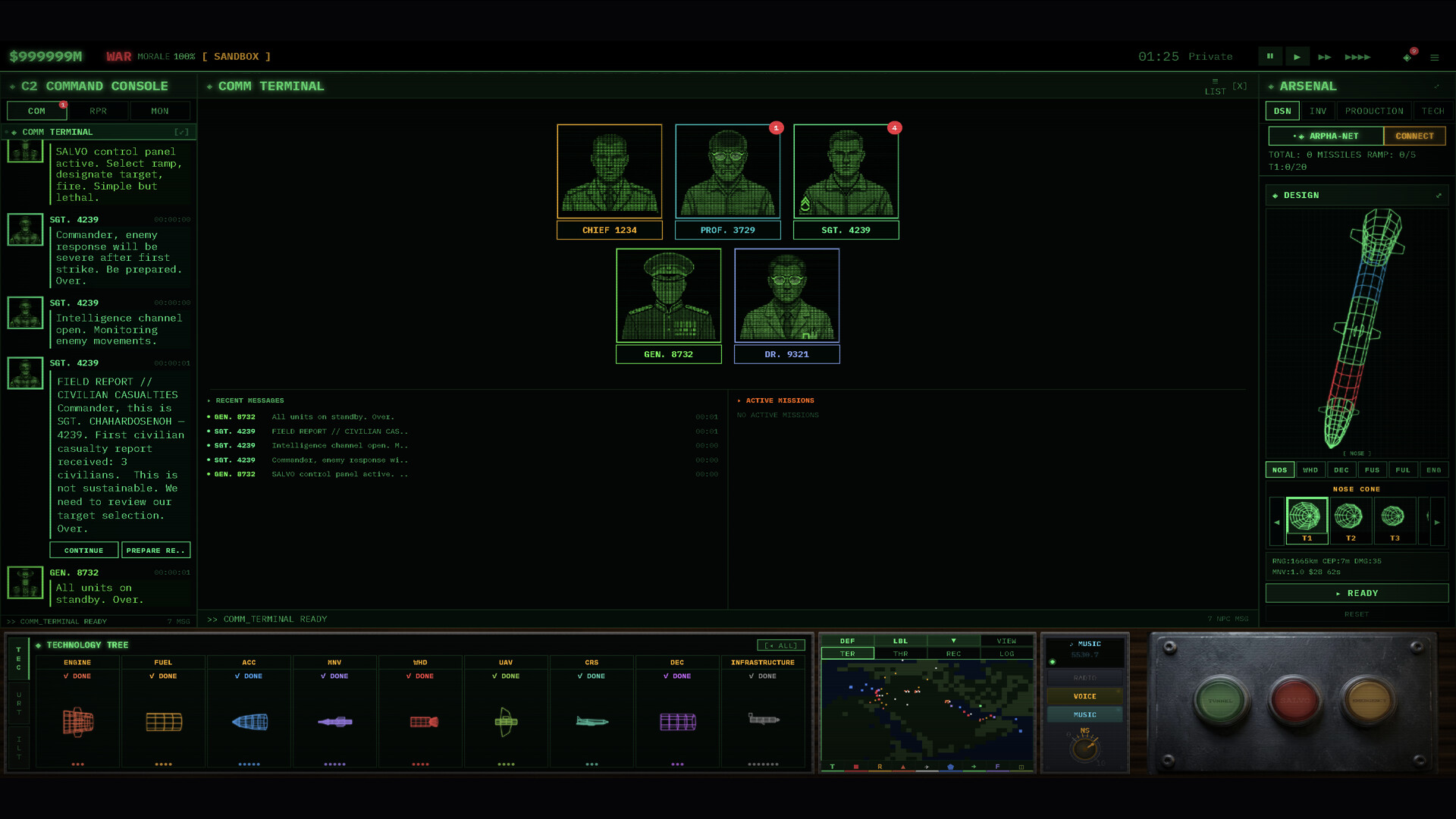
You determine the engine, fuel, guidance system, maneuver package, and payload. You name the resulting design, save it as a blueprint, and send it into production.
Every saved design becomes a separate production plan. Which one you mass-produce, which one you stockpile, and which one you reserve for a critical operation is entirely up to you.
DON'T PULL THE TRIGGER — PLAN A SALVO
In Salvo, an attack is not about pressing a single button and sending missiles at random. Every operation is a pre-planned strike package.
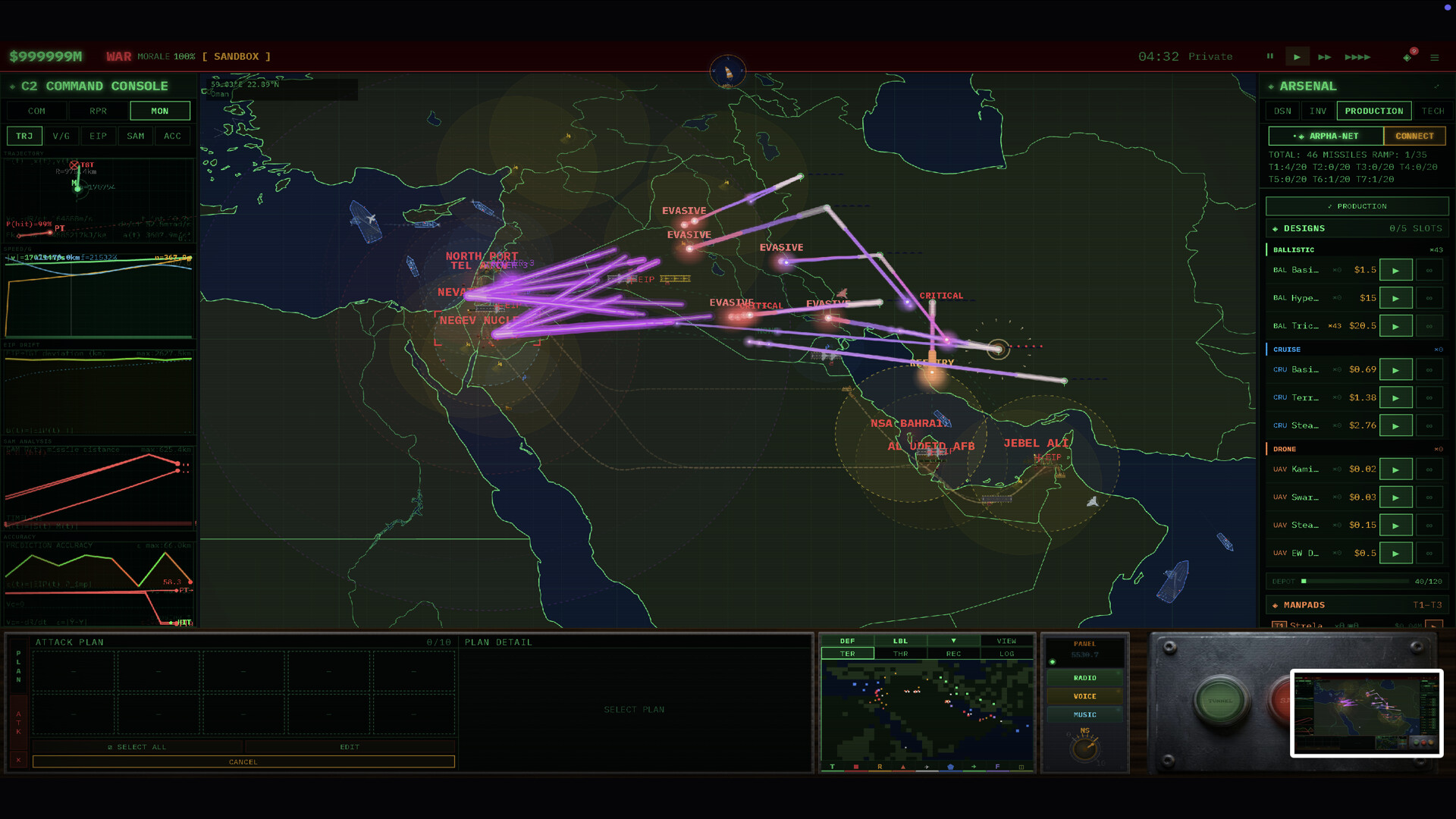
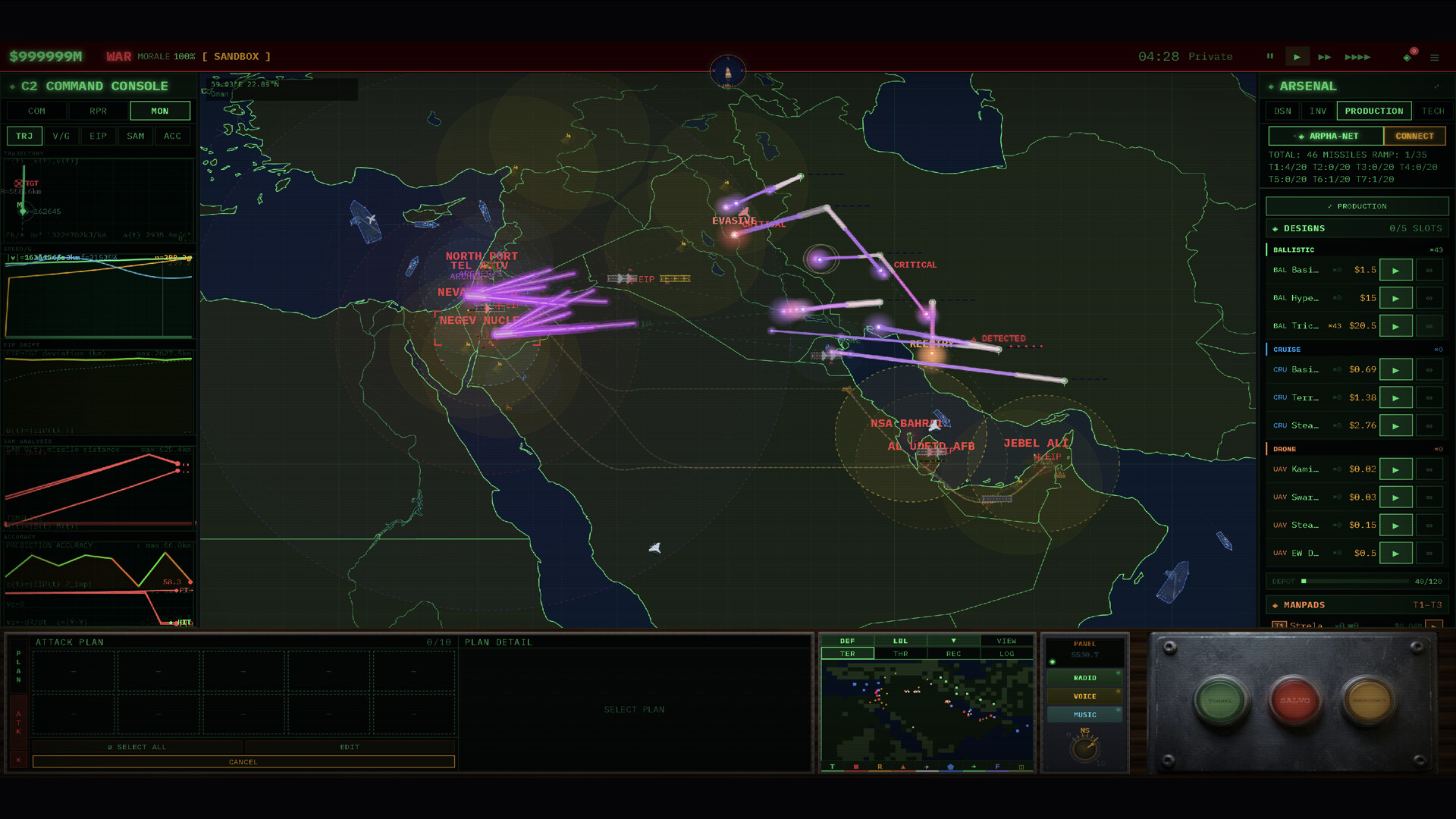
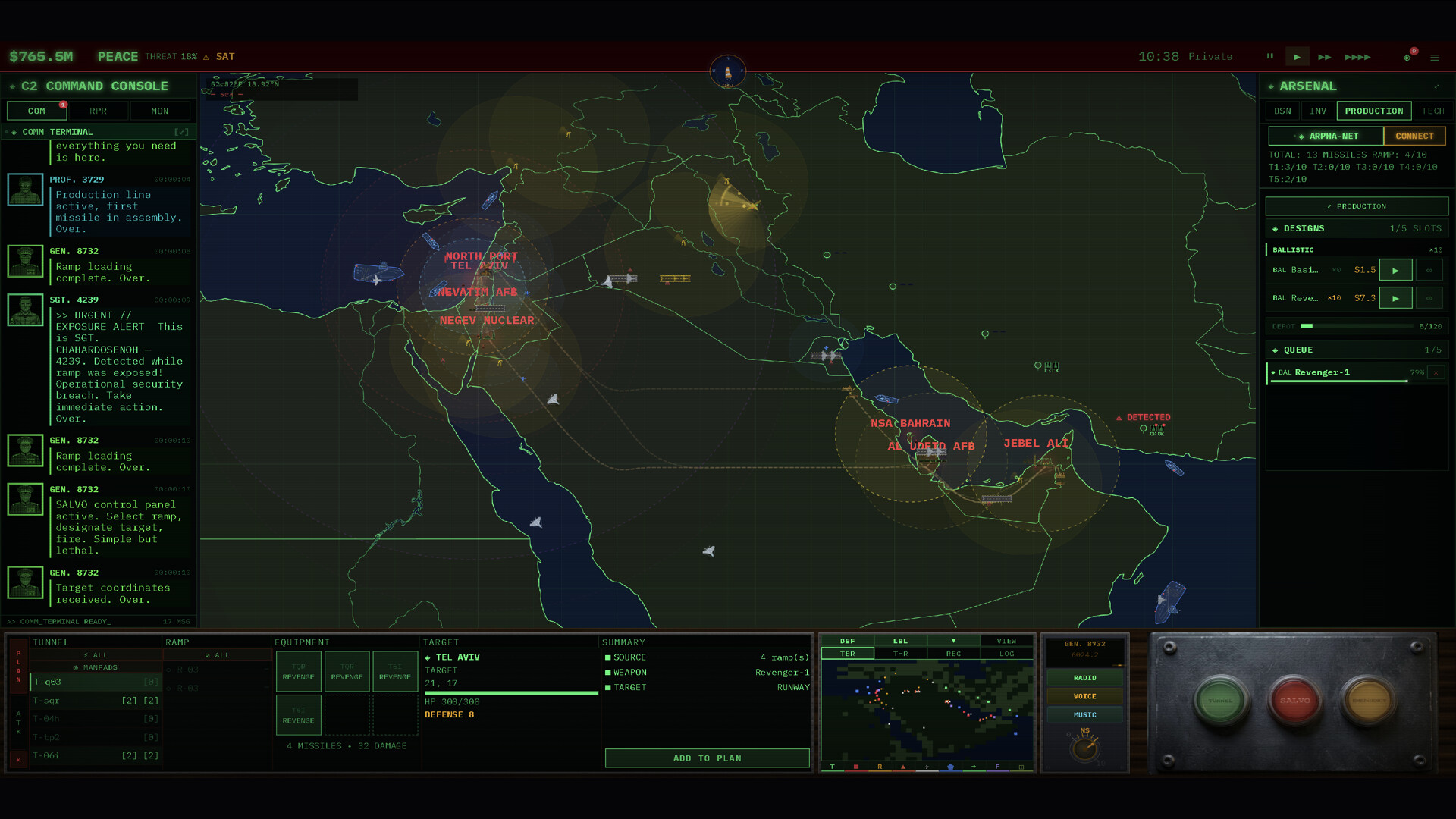
In the KGP planning panel, you can prepare up to ten attack orders at once. For each strike, you choose the target, the munition, and the launcher separately. You can direct every launcher at a single target, or build a mixed operation split across multiple targets at the same time.
When you execute the plan, the selected strikes are launched within the same operational wave. Then you can plan again, sending a second wave or follow-up attack based on how the defense reacts.
A well-planned salvo confronts the defense with too many threats, too many targets, and too little reaction time all at once.
REAL PHYSICS. NO DICE.
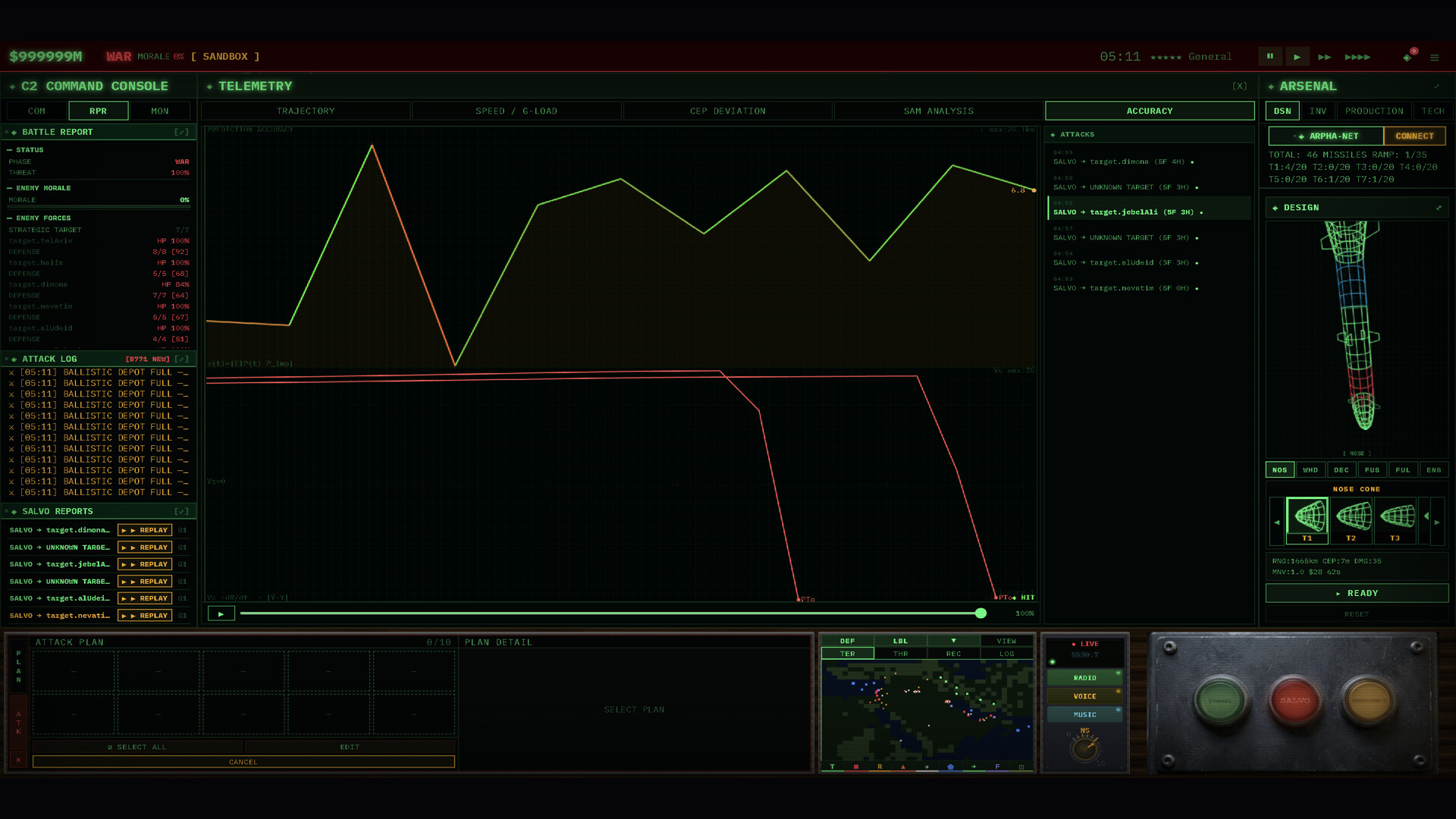
In Salvo, missiles are not animations sliding across the screen. Every launch is calculated by the physics engine from motor ignition to impact or interception.
The Tsiolkovsky rocket equation determines the velocity a missile can reach with the fuel it carries. Warhead weight changes range. Body shape affects aerodynamic drag. Fuel type, burn behavior, and altitude profile shape the flight characteristics. Atmospheric density, speed, altitude, radar cross-section, and wind can produce different results in every flight.
There is no pre-drawn path where "missile A goes to target B."
Tsiolkovsky, aerodynamic drag, RK4 altitude integration, atmospheric modeling, radar cross-section, INS drift, CEP, and interception geometry are all parts of the same chain.
The game does not show you a "62% hit chance" and roll dice behind the curtain. Physics runs. Radars look. Defenses calculate. The missile either gets through or falls.
This is not a trick. This is physics.
ARPHA-NET: THE WAR'S INTERNAL LIBRARY
In Salvo, the information you need is not hidden outside the game.
ARPHA-NET is the knowledge archive of the underground command network. From missile classes to air defense layers, radar logic to munition types, research topics to operational concepts, you can study the systems you encounter in the game from within it.
What is CEP, why does the radar horizon matter, what changes between a cruise missile and a ballistic missile, and why does a saturation attack work — the answers to these questions exist inside the game world.
KOL ŞAHAR: THE LIVE RADIO OF WAR
Kol Şahar is a dynamic war radio system designed from the ground up for Salvo. It is not a simple music playlist or background ambience. It is a live broadcast layer that follows, interprets, and retells the war you wage through its own language of propaganda.
Thousands of original fully voiced audio pieces in Turkish are dynamically combined throughout the game for news bulletins, regular programs, debates, field reports, technical briefings, crisis announcements, and propaganda transitions.
When you fire a salvo, the studio broadcast may be interrupted. When a radar is struck, a field reporter may cut in. If the defense stops every threat, the broadcast may shift into a tone of victory. If a hypersonic missile breaks through the defenses, a few seconds of silence may fall over the transmission. During major losses, the presenter's professional voice may begin to crack.
The radio does not only answer the question "what happened"; it also shows how what happened is explained to the public.
COMMAND TERMINAL
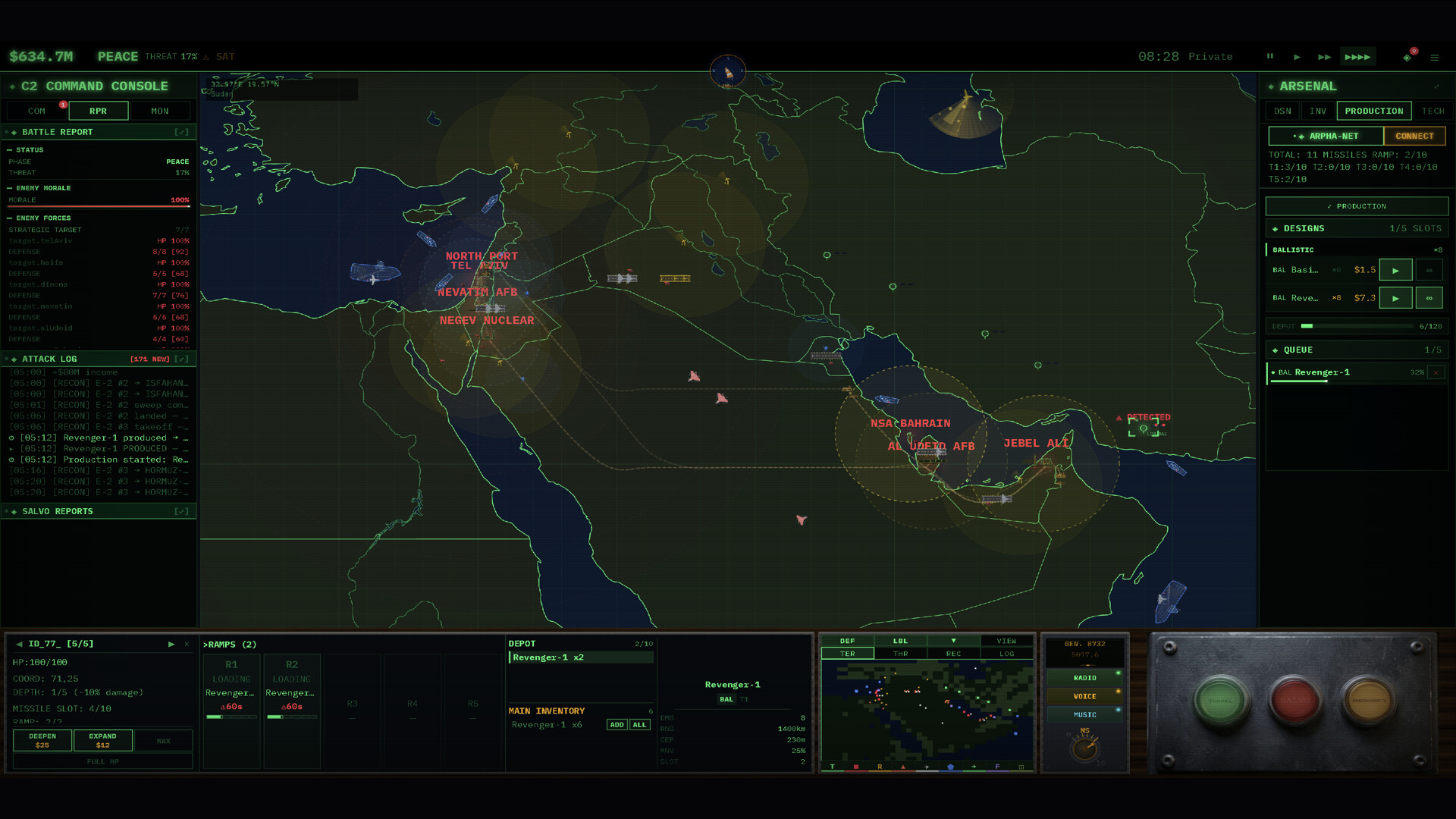
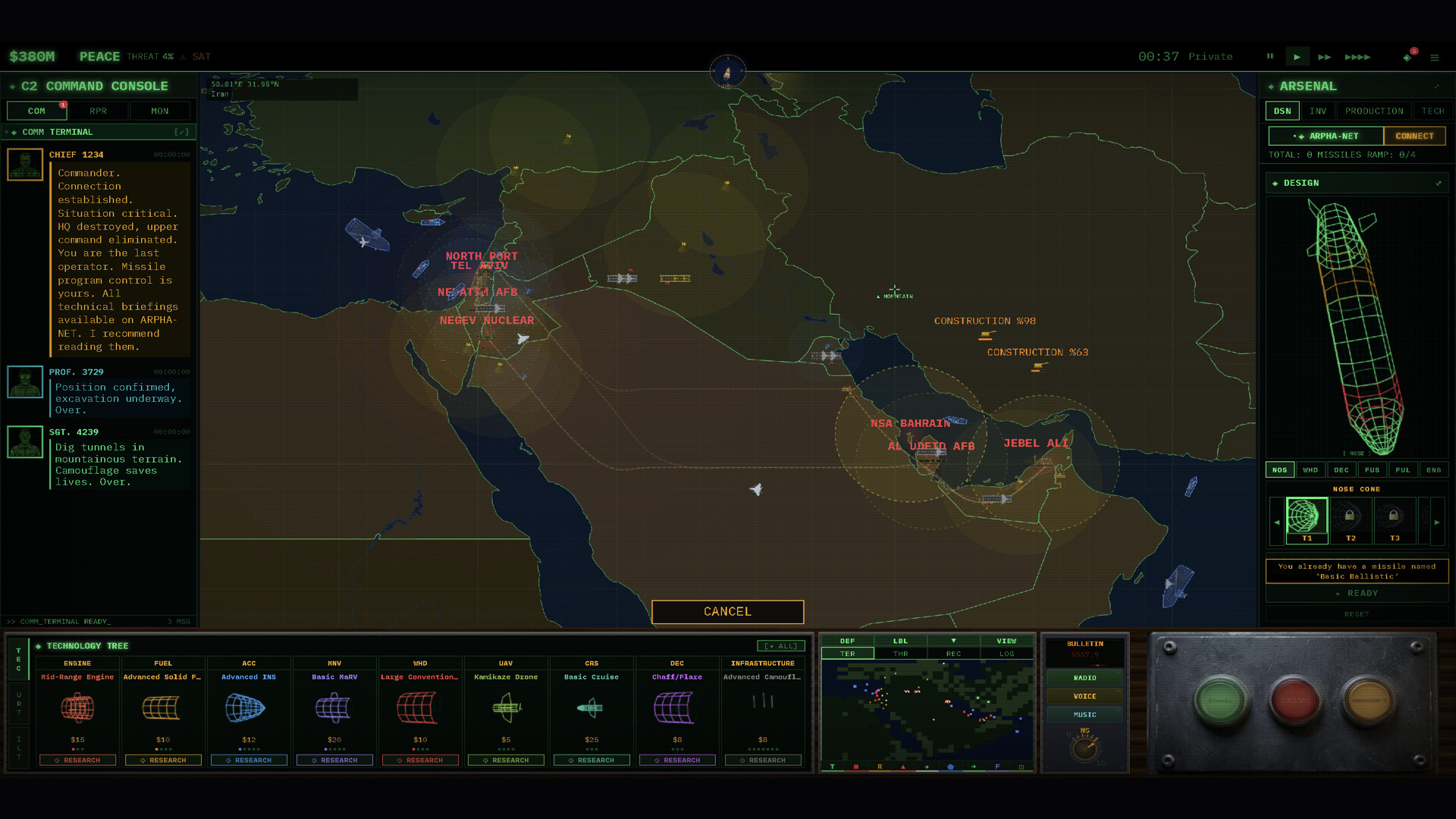
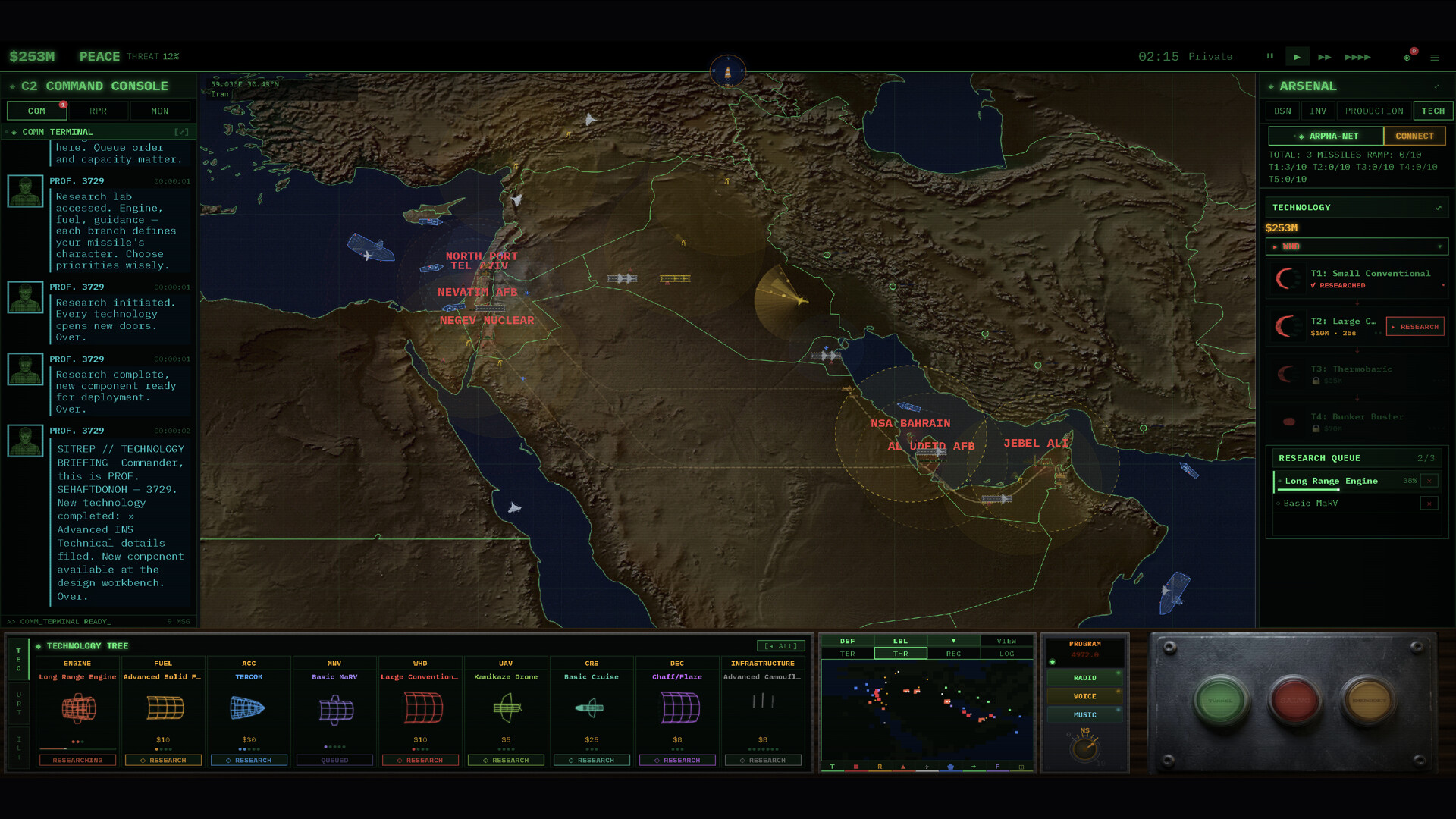
Salvo is presented like a military command terminal from 1991. Phosphor screens, dense tactical panels, NATO-style symbology, monospace typography, procedural combat audio, and radio broadcasts all belong to the same interface language. This is not a retro filter added on top of the game. It is the way the war is seen.
KEY FEATURES
Real physics-based missile simulation: Tsiolkovsky, RK4, aerodynamic drag, and atmospheric modeling
Advanced guidance systems based on MPPI and ProNav
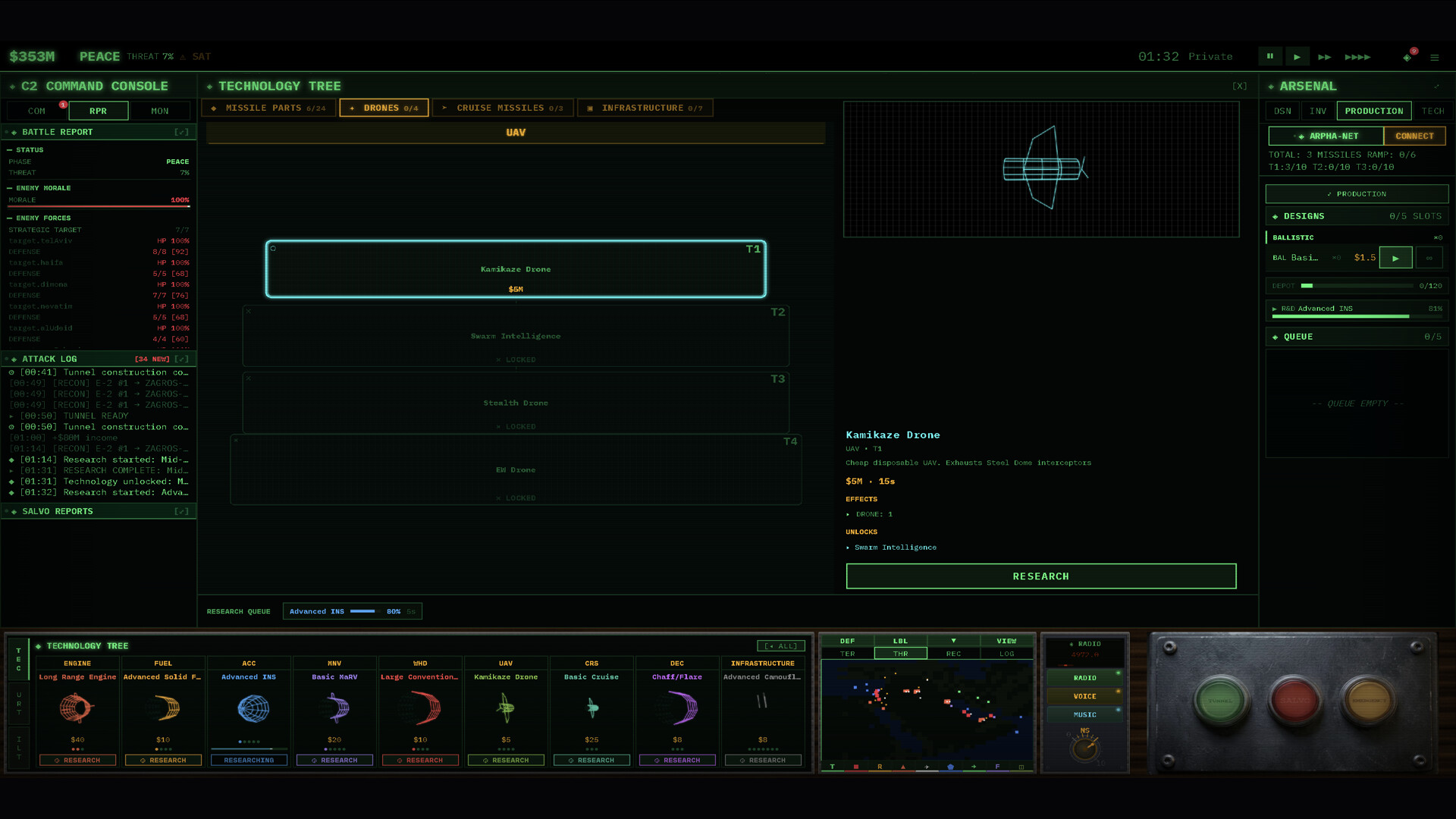
8-branch nonlinear technology tree
5-stage evasion system and 3-zone radar degradation
Layered enemy SAM network: Archer-2, Archer-3, Stone Sling, Steel Dome, Patriotic, and close-in defense guns
24 story missions, procedural Normal mode, and unlimited Sandbox
6 languages: Turkish, English, Arabic, Persian, Russian, and Spanish
Kol Şahar radio system: 1,900+ audio files and 6,720+ dynamic broadcast segments, with full Turkish and English voiceover
Underground missile complex: 10 tunnels, 5 launchers, 5 depth levels, and mountain tunnel option
Rank progression: from Lieutenant to Marshal
Dynamic morale, threat level, satellite intelligence, and enemy counterattack systems
Modular weapon production and salvo planning for up to 10 attacks