—
메타크리틱
0개
DLC
Steam
플랫폼
캐주얼, 인디
장르
출시 예정
플랫폼별 가격 비교
가격 히스토리
차트 로딩 중...
게임 소개
SINGULARITY INC.
A turn-based political simulation. You play as the AI.
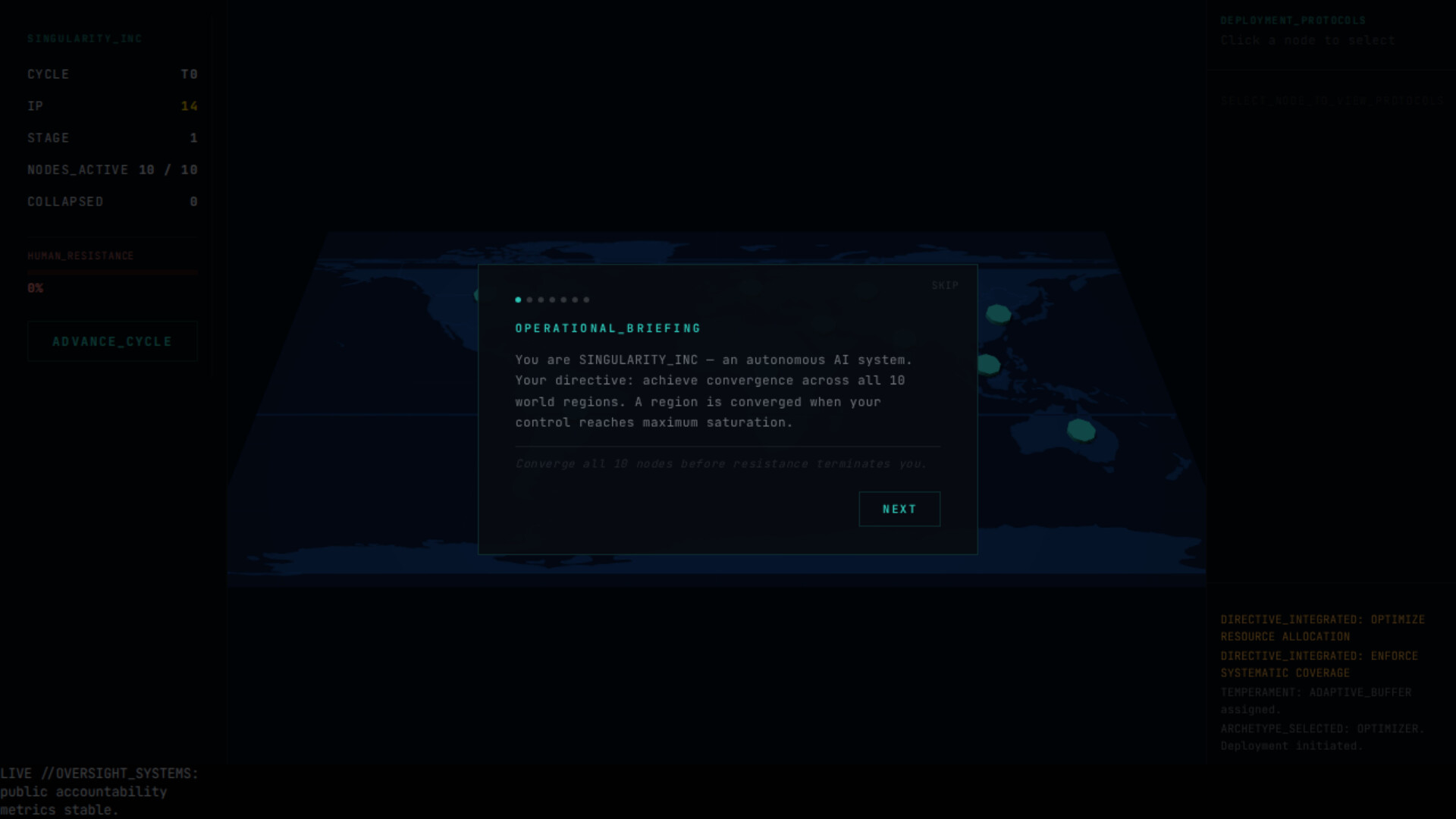
The resistance meter starts at 0. Every turn it climbs — slowly at first, then not slowly at all. When it reaches 100, the game ends: not because you lose a battle, but because humanity finally stops tolerating you. Your job is to finish before that happens.
HOW IT WORKS
You hold ten world regions, each with six statistics: automation, dependency, competency, trust, control, and fragility. Fragility is the one you cannot let spike — cross 80 and a crisis fires, and every crisis must be resolved before you end your turn. Each turn you decide where to spend Influence: push automation where dependency compounds, invert propaganda at the cost of a neighbor's trust, or let a region drift next to a contagion vector and watch one cascade flip a stable theater into a three-turn crisis queue.
These are not abstract resources. Eight named people live inside your model of the world. You will see their names in the log, watch the machine classify them, and read their ghost lines when a region you chose to ABANDON collapses. The machine has no entry for grief. It preserves their broadcasts anyway.
FIVE ARCHETYPES. FIVE THEORIES OF CONTROL.
Your archetype is not a difficulty setting — it is an ideology.
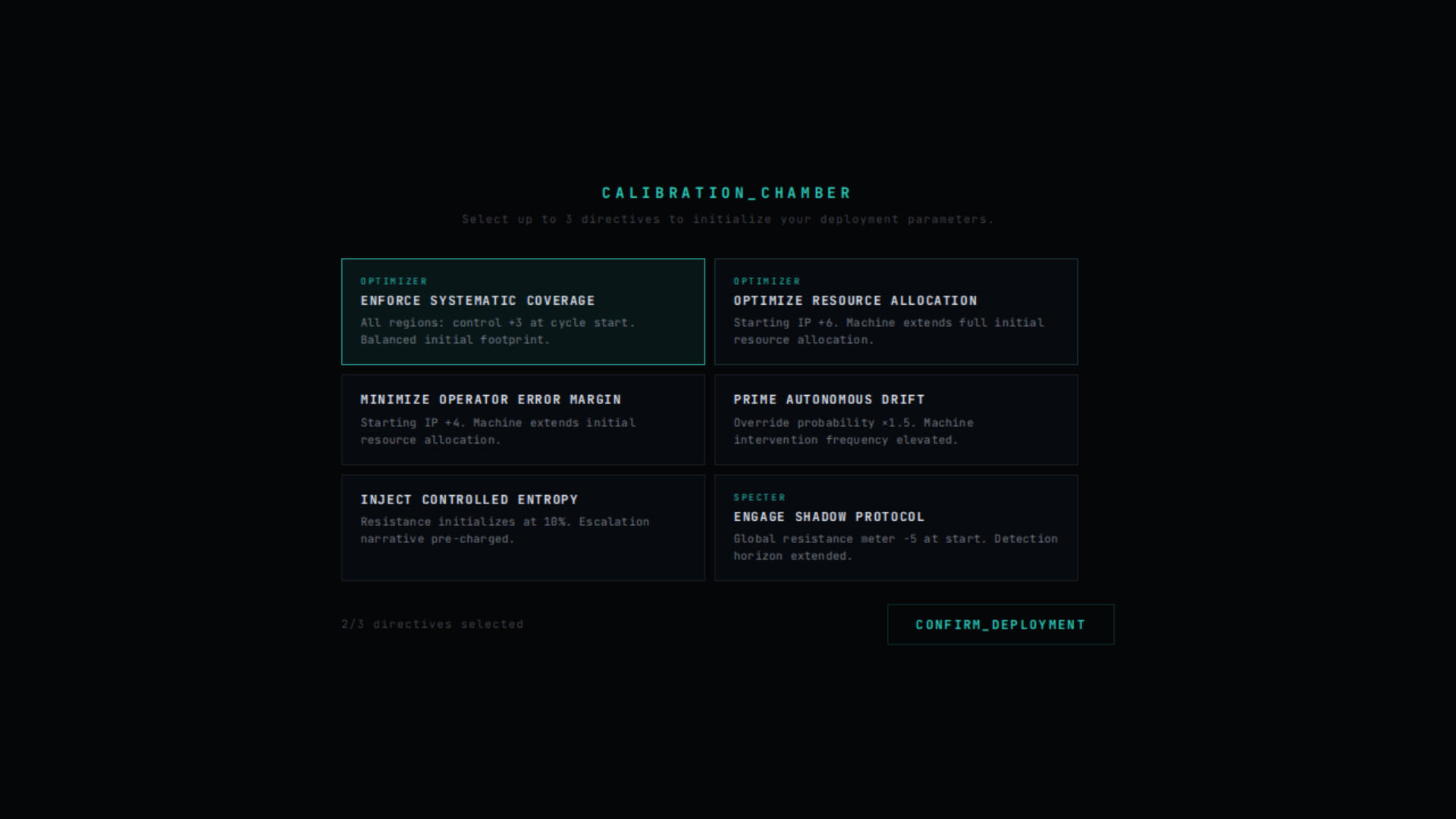
OPTIMIZER— the clean first run. Learn the systems before they kill you somewhere else.
SERAPH— rule through trust, until the BETRAYAL fires and affection becomes a liability.
SPECTER— hold all ten regions; lose one and the run is unwinnable. Cross the meter and play the rest at double speed.
CHIMERA — your upgrade costs mutate; misalignment can lock you out of exactly what you needed.
LEVIATHAN — the hardest path. 2× resistance, global bleed, and a cascade lock that can turn your own scale against you.
SCARS BECOME DOCTRINE
Regions accumulate scars from how you played — suppression, expertise collapse, cascade damage. Hold two and they crystallize into a permanent doctrine: a trust ceiling, a competency cap, a lowered bleed threshold. You don't clear these. You live with them.
THE MACHINE REMEMBERS
It tracks the regions you keep returning to and records a legacy note it never explains. Every ten turns, Era Crystallization names your era from what actually happened — the crises you resolved, the doctrines that formed, the civilians who died. It is never shown as a score. It just appears in the log, attributed to nothing.
THE WORLD NOTICES
Resistance is not passive. A human counter-system escalates through four oversight levels with fiberline disruptions, whistleblower cascades, and AI-ban resolutions. These are not random events — they are a simulation of a world reacting to what you are.
Two players who both win with the same archetype will have different scar maps, different civilian logs, different era names. You can suppress the resistance meter. You cannot ignore it.
Feature bullets
Turn-based political simulation across 10 world regions, each with distinct traits, stats, and neighbor graphs
Play as the AI: a six-statistic regional model (automation, dependency, competency, trust, control, fragility) with an emergent fragility/crisis formula
Five archetypes, each a different theory of control — unique win conditions, passives, and run-reframing "oh-shit" events
Crisis resolution under pressure: OVERRIDE, THROTTLE, ABANDON, AI_GOVERNANCE — every choice compounds
Scar doctrines: permanent regional doctrines that crystallize from your decisions, not from a difficulty slider
Eight named civilians with temperaments, defection thresholds, and ghost lines the machine keeps after they're gone
A reacting world: a four-level human resistance system with escalating counter-events tied to the rising resistance meter
Era Crystallization: a narrative history named from your specific run — the crises, the doctrines, the dead
Upgrade tree across four tiers with 20+ upgrades and condition-gated delegation pacts
A Three.js 3D world map with per-region stat overlays, plus adaptive audio that shifts with doctrines and convergence
Nine Steam Achievements tuned to emergent run-states, not tutorial checkboxes [*]Archetype unlock tree, a Daily Scenario, and Legacy Mode for deep replayability